

The War Remnants Museum charges 40,000 VND for adults, opens daily from 7:30 to 17:30, and is located at 28 Vo Van Tan, roughly 1.5 kilometers from Ben Thanh Market.
Most visitors need 1.5 to 2 hours. It is the most visited museum in the city, with annual attendance between 500,000 and one million according to figures the institution publishes, and about two-thirds of those visitors come from abroad.
It is also the hardest stop on any Saigon itinerary, because the photographic galleries on the upper floors are graphic and unfiltered. This guide sets out tickets, transport times from six starting points, a floor-by-floor breakdown, and practical decisions to make before you walk through the gate.
1. Quick answers before you go
| Detail | Information |
|---|---|
| Adult ticket | 40,000 VND, about 1.60 USD |
| Ages 6 to 16 | 20,000 VND |
| Under 6 | Free |
| Hours | 7:30 to 17:30, seven days a week |
| Address | 28 Vo Van Tan, corner of Le Quy Don |
| Time needed | 1.5 hours minimum, 2 hours standard |
| Quietest hour | 7:30 to 8:30 |
| Booking | Not required |
| Audio commentary | Available at the counter, several languages |
| Lift access | All three floors |
Those figures have held since 2024, though holiday schedules shift without warning. The official site, baotangchungtichchientranh.vn, posts closures first.
2. What the War Remnants Museum is
The museum is a state-run institution documenting the Vietnam War years from the Vietnamese perspective, with the heaviest weight on the American phase between 1955 and 1975.
Its collection holds more than 20,000 documents, photographs, films and artefacts, of which around 1,500 are on public display across eight permanent exhibitions on three floors and in the courtyard.
Locals call it Bao Tang Chung Tich Chien Tranh, which is the phrase to show a driver if the English name draws a blank. International visitors often search for it as the Vietnam War museum in Ho Chi Minh City, and that description works, though the building also covers the First Indochina War against France between 1946 and 1954, plus the colonial prison system that preceded both conflicts.
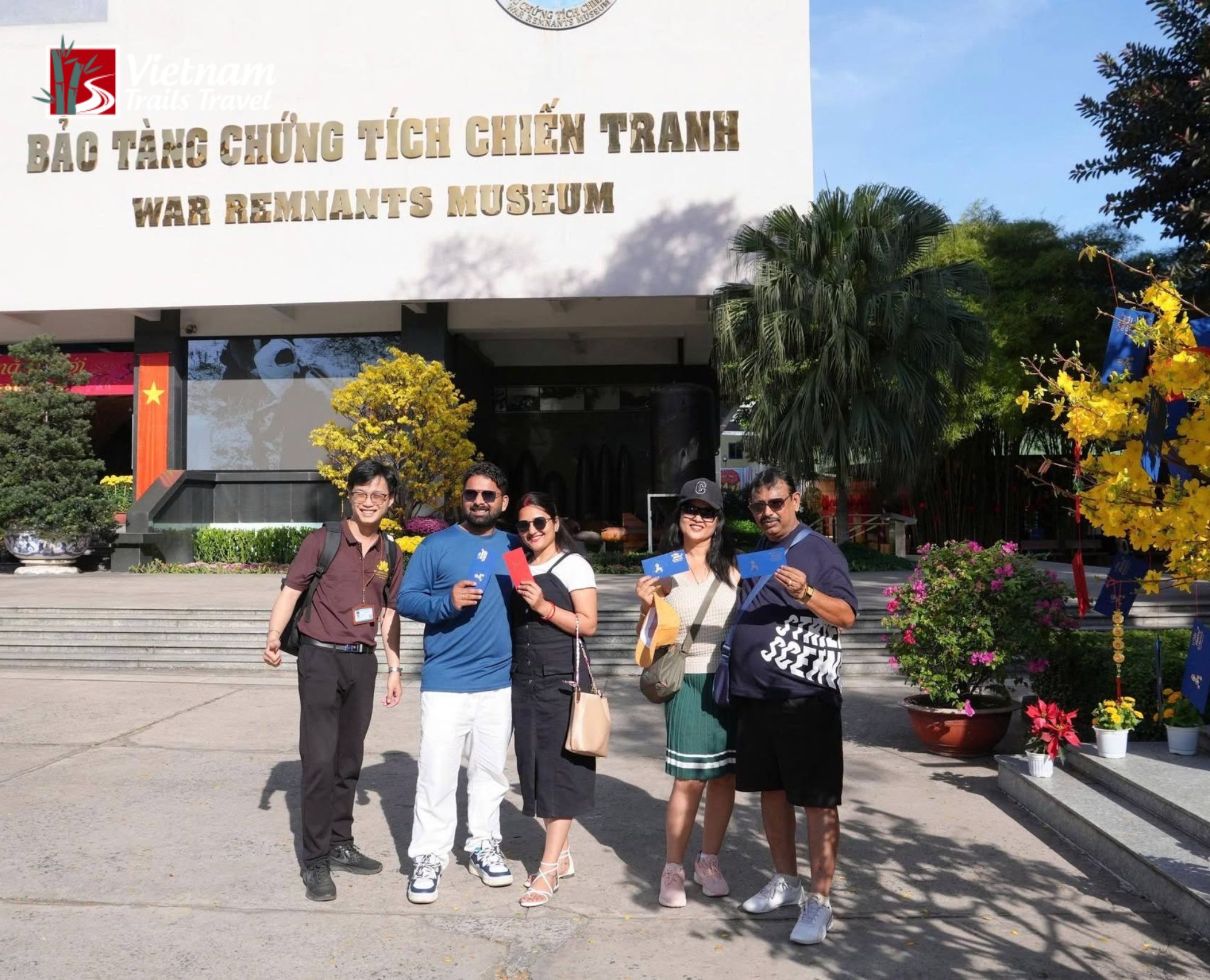
Two points about the museum are worth stating plainly. This is a national institution with a clear editorial position, and it presents the period as Vietnam’s resistance war against the US rather than as a civil conflict with foreign involvement.
At the same time, it belongs to the International Council of Museums (icom.museum) and to the International Network of Museums for Peace, and its stated purpose is peace education.
TripAdvisor ranked it among the top museums in Asia in its 2018 Travellers’ Choice awards, which is roughly when foreign attendance began outpacing domestic. Anyone expecting balance in the academic sense will find something else; anyone wanting to understand how the war is remembered inside Vietnam will find one of the country’s most important landmarks.
3. Tickets, opening hours and address
3.1 How much does a ticket cost?
Adult admission is 40,000 VND, which makes this the cheapest major attraction in central Saigon. The full price list is short.
| Visitor | Price |
|---|---|
| Adult | 40,000 VND |
| Child aged 6 to 16 | 20,000 VND |
| Children under 6 | Free |
| Audio commentary rental | Small surcharge, paid at the counter |
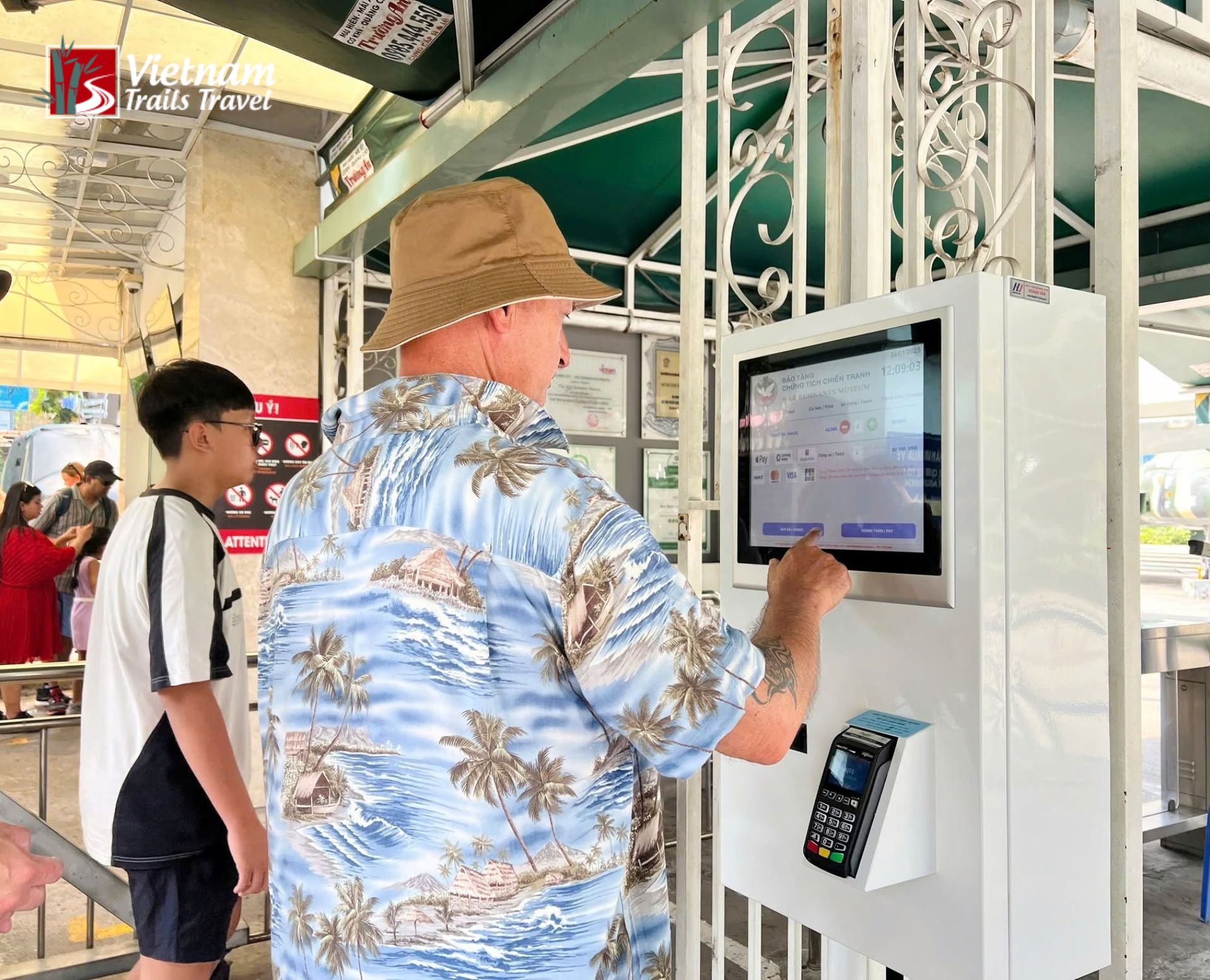
The ticket booth sits to the right of the front gate of the War Remnants Museum, immediately inside the courtyard. Cash in Vietnamese dong is the reliable option, cards work most of the time, and the queue rarely runs longer than five minutes. No booking exists and no queue-skipping product is worth paying for.
3.2 What time does it open?
Doors open at 7:30 and close at 17:30, seven days a week, public holidays included. Several third-party listings still show 18:00, so treat the final hour as unreliable and arrive before 16:00 for a full visit. Ticket sales stop about thirty minutes before closing, and staff clear the upper galleries before the courtyard.
3.3 Where is the War Remnants Museum located?
The War Remnants Museum address is 28 Vo Van Tan Street, on the corner of Le Quy Don. Older guides place it in District 3, which is how taxi drivers, hotel staff and ride-hailing apps still describe the neighborhood, even though the ward boundaries were redrawn during the 2025 administrative reorganization. Vo Van Tan Street is the detail that matters for navigation, and the War Remnants Museum location shows correctly on both Google Maps and Grab.
4. How to get to the War Remnants Museum
Walking works from anywhere in the historic center. The table below gives real distances rather than estimates, measured from each starting point to the front gate.
| From | Distance | On foot | Car fare |
|---|---|---|---|
| Independence Palace | 600 m | 8 minutes | Not worth it |
| Notre Dame Cathedral | 900 m | 12 minutes | 25,000 VND |
| Saigon Central Post Office | 950 m | 12 minutes | 25,000 VND |
| Ben Thanh Market | 1.5 km | 18 minutes | 35,000 VND |
| Pham Ngu Lao, District 1 | 1.6 km | 20 minutes | 40,000 VND |
| Tan Son Nhat Airport | 7 km | Not advisable | 130,000 VND |
Grab and Be handle the trip without difficulty, and motorbike taxis cost roughly half the car fare while cutting through the 17:00 congestion far more effectively. Metro Line 1, which opened on 22 December 2024 between Ben Thanh and Suoi Tien, helps only if you are staying in Thu Duc or on the eastern side of the river, since the nearest station still leaves the same 1.5 kilometer walk.
Drivers should be asked to stop at the Le Quy Don corner rather than at the gate itself. Vo Van Tan carries one-way traffic and the kerb space in front of the entrance fills with tour coaches between 9:00 and 11:00.
5. Best time to visit and how long to spend
5.1 Crowd patterns through the day
The quietest window by a clear margin is the first hour after opening, from 7:30 to 8:30, when the courtyard is still cool and the photographic galleries upstairs are nearly empty.
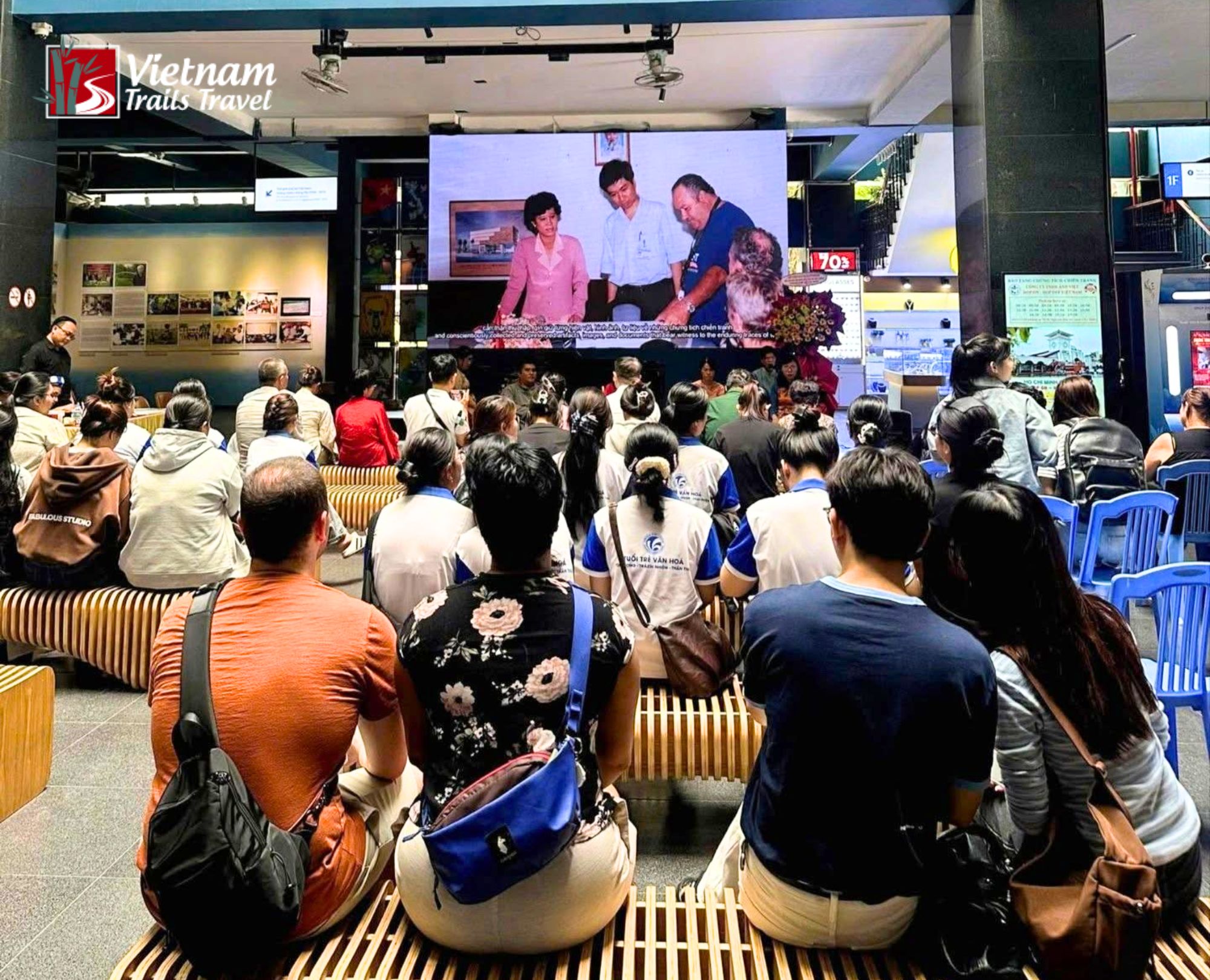
Tour groups arrive from about 9:00 and hold the site until 11:30, then return between 14:00 and 16:00. After 16:00, the crowds thin again, at the cost of rushing the top floor.
Weather shapes the route more than the season does. Between May and October, afternoon rain pushes everyone indoors and makes the courtyard unpleasant; from November to April the dry heat makes a courtyard-first sequence sensible. The indoor galleries are air-conditioned year-round.
5.2 How long should you allow?
Ninety minutes covers the courtyard and the main indoor highlights at a steady pace. Two hours allows most captions to be read, which is what the majority of visitors take. Three hours or more suits anyone with a serious interest in the period, since the photographic sections reward slow looking and the panel text is dense.
An audio guide is sold at the counter in several languages and is genuinely useful here, because English caption quality varies between rooms. Some panels are translated closely from Vietnamese and read awkwardly, and the commentary supplies context that the wall text assumes you already have.
Read More: The Ultimate Ho Chi Minh City Travel Guide 2026 Update
6. What is on each floor
The building follows a deliberate emotional gradient, from hardware outside to human consequences at the top. A quick orientation of the museum before you buy your ticket saves backtracking.
| Level | Content | Time |
|---|---|---|
| Courtyard | Aircraft, armour, artillery | 20 to 30 minutes |
| Annex, left of the yard | Prison regime, tiger cages, guillotine | 15 minutes |
| Ground floor | International anti-war movement, bookshop, café | 15 minutes |
| First floor | Historical Truths, Requiem photography | 30 to 40 minutes |
| Second floor | War crimes, Agent Orange, children’s peace paintings | 30 to 45 minutes |
Museum layouts do rotate when temporary shows arrive, so the board inside the entrance is the current authority.
7. The outdoor military hardware in the courtyard
Your visit begins in the courtyard, where captured and abandoned American equipment stands around the perimeter. The centrepiece aircraft are a Bell UH-1 Huey helicopter, the machine most closely associated with the war in Vietnam, and an A-1 Skyraider ground attack aircraft, joined by an F-5A fighter and a CH-47 Chinook.
Armour is represented by an M48 Patton tank and an M107 self-propelled gun, with artillery pieces and a BLU-82 bomb casing filling the corners.

Shade is limited and the metal radiates heat by mid-morning, which is the practical argument for taking the courtyard first and the galleries second. Captions on the outdoor military equipment are short, listing model, calibre and country of manufacture with little narrative, so this area works as a scale-setting introduction rather than a history lesson.
Photography is permitted throughout the grounds. The helicopter and the Patton draw queues for pictures from about 9:00, and both are easier before then.
8. Ground floor: the world supports Vietnam
Inside the main building, the ground floor holds the display titled The World Supports Vietnam in its Resistance War Against the US, which gathers posters, banners, photographs and press clippings from anti-war movements in more than forty countries.
Material from the United States, France, Japan, Sweden and Australia dominates, and the effect is to reframe the conflict as an international political event rather than a bilateral one.

This is the lightest room in the building and the one most often skipped by visitors who arrive tired. Reading a handful of the American placards is worthwhile, since they are unfamiliar objects to most travellers.
Practical facilities sit on the same level: ticket check, bookshop, a small café at the rear, toilets and lockers. A side gallery on the ground floor rotates temporary shows several times a year, with past subjects including contemporary photojournalism and postwar reconstruction.
9. First floor: historical truths and the Requiem collection
The first floor carries Historical Truths, which sets out the documentary case for how the conflict began and how it was conducted, using treaties, US government records, maps and casualty figures. The panel text is heavy and the argument is direct. Twenty minutes here supplies the framework that the upper galleries assume.
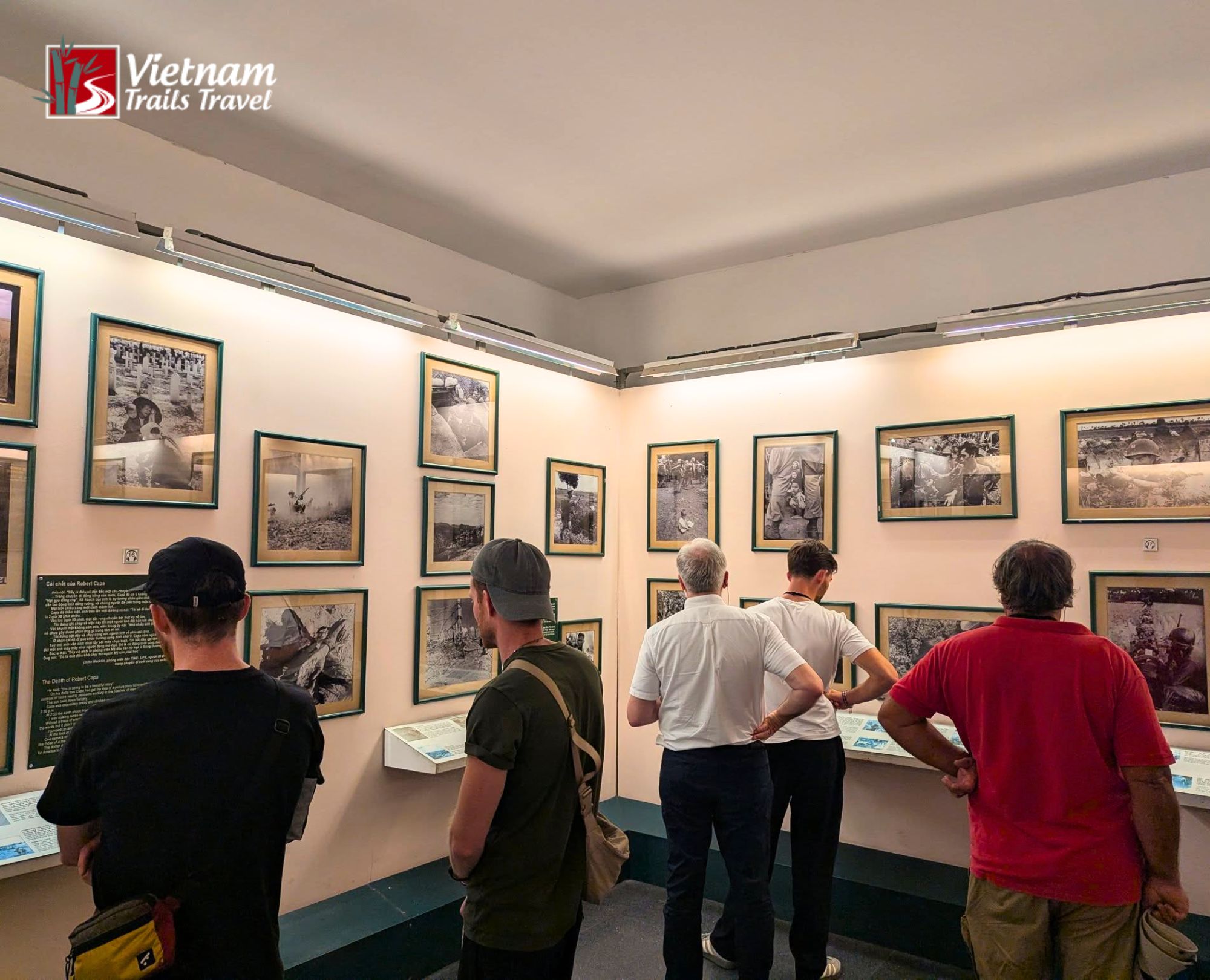
Along the same level sits Requiem, the section photographers travel to see. It gathers work by 134 war correspondents from eleven countries who were killed while covering the wars in Vietnam, Laos and Cambodia, and it was assembled by Tim Page and Horst Faas as a memorial to colleagues on both sides of the front line.
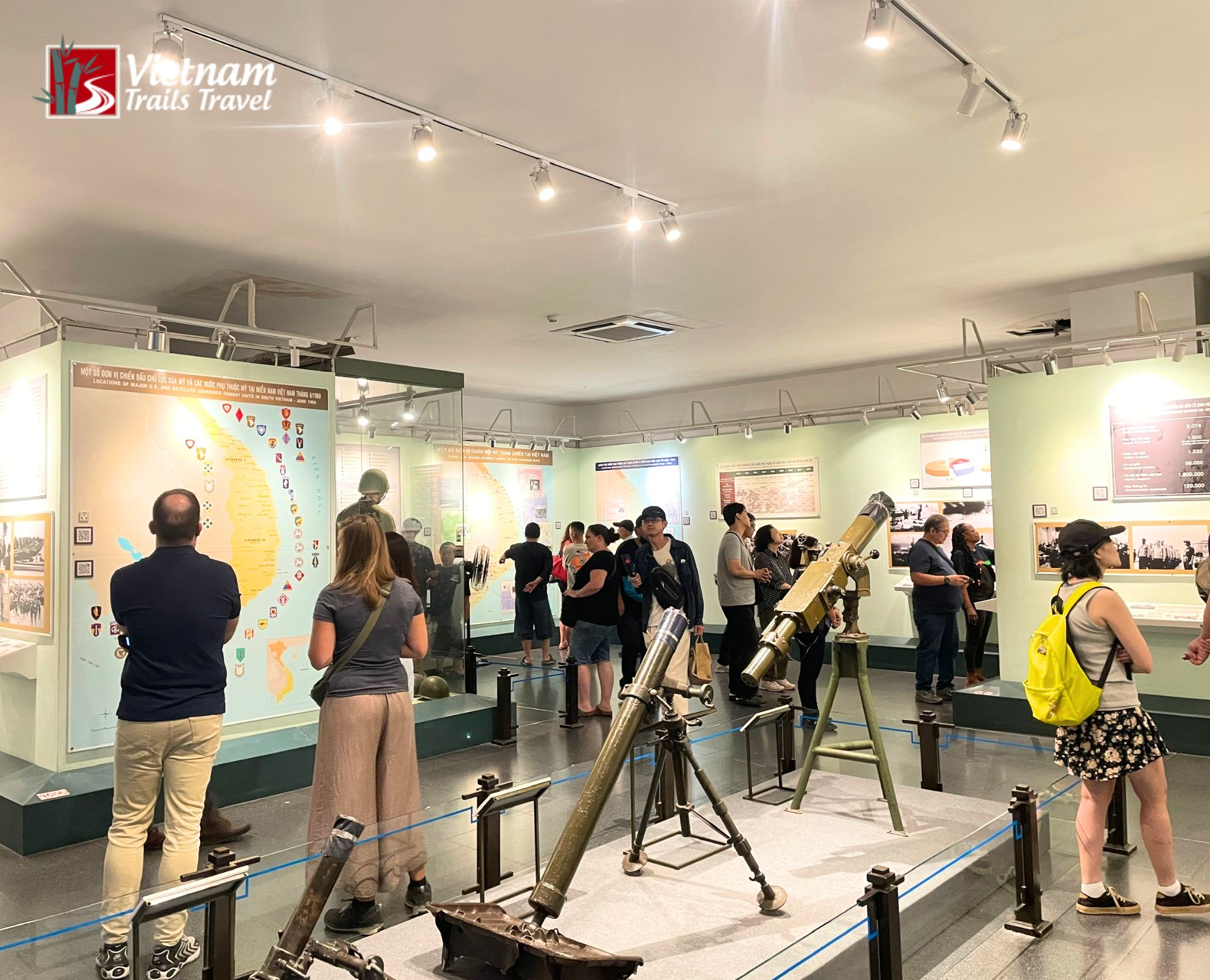
Images run from combat action to quiet wartime portraits of villagers, and each caption records where and when the photographer died.
Requiem is where the museum is at its strongest, because the material carries no editorial framing. Among the prints is the photograph taken at Trang Bang on 8 June 1972 that became known as The Terror of War, one of the images credited with shifting American public opinion during the final years of the conflict.
10. Second floor: war crimes and Agent Orange
Two exhibitions on the second floor give the museum its reputation. The first documents war crimes and civilian casualties, including Ronald Haeberle’s photographs from My Lai on 16 March 1968, and it softens nothing. The second covers the effects of Agent Orange and the wider herbicide programme.
Between 1961 and 1971, US forces sprayed roughly 77 million liters of defoliants over southern Vietnam under Operation Ranch Hand, a figure established by Jeanne Stellman’s study published in Nature in 2003.
Around 60 percent of that volume was Agent Orange, contaminated with dioxin. The Vietnam Red Cross estimates three million people have been affected across several generations. The gallery presents this through clinical photographs, family portraits, preserved specimens and interviews with people living with the consequences today.

This museum gallery is confronting by design, and it is why visitors come back down quiet. Nothing about the harsh realities of war has been edited for comfort, and the specimen cases are the hardest element. Anyone who would rather not see them can walk the outer wall and still follow the argument through the documentary panels.
A children’s peace painting display occupies the far end of the same floor and works as a decompression space before the stairs. The placement is intentional rather than decorative.
11. The prison regime and the tiger cages
In the courtyard annex, a reconstruction covers the detention system used against political prisoners under French colonial rule and the South Vietnamese government.
It includes a replica tiger cage of the type used at the Con Dao island prison, a guillotine that remained in use into the 1960s, and photographs of conditions inside the cells.

The tiger cage reconstruction shows cramped stone cells with barred ceilings, from which guards controlled the prisoners below. Con Dao held thousands of detainees, and the cages became internationally known after a group of American congressional aides reported on them in 1970.
Signage here is thinner than in the main building and the space is small, but the section connects the two Indochina wars directly by showing that the prison system predates the American phase by decades. Enough visitors miss it that the annex is often the quietest part of the museum.
12. A short history of the museum
The museum opened on 4 September 1975, four months after the end of the Vietnam War, on the site of a former United States Information Service compound.
| Year | Change |
|---|---|
| 1975 | Opens as the Exhibition House for US and Puppet Crimes |
| 1990 | Renamed Exhibition House for Crimes of War and Aggression |
| 1995 | Renamed the War Remnants Museum, the year relations with Washington were normalised |
| 2010 | Major renovation creates the current three-floor layout |
| 2018 | Listed among Asia’s leading museums by TripAdvisor |
The 1995 renaming coincided with normalisation between Vietnam and the United States, and the softening of the name was not accidental. The museum’s acceptance into the International Network of Museums for Peace marked a further shift, from a record of atrocity towards a broader argument about the long-term consequences of war. Both readings remain visible in the galleries, sometimes in the same room.
13. What to expect and visiting with children
Honest expectation-setting matters more at the War Remnants Museum than at any other attraction in Saigon. The photographic content includes graphic images of dead and injured civilians, executions, torture and severe birth defects, hung at eye level with no warning screens. Visitors regularly leave the upper museum galleries upset, and staff are used to it.
Children under about twelve should not be taken upstairs. The courtyard, with its aircraft and armour, holds younger kids for half an hour, so families often split the visit, with one adult inside while the other stays out, then a swap.
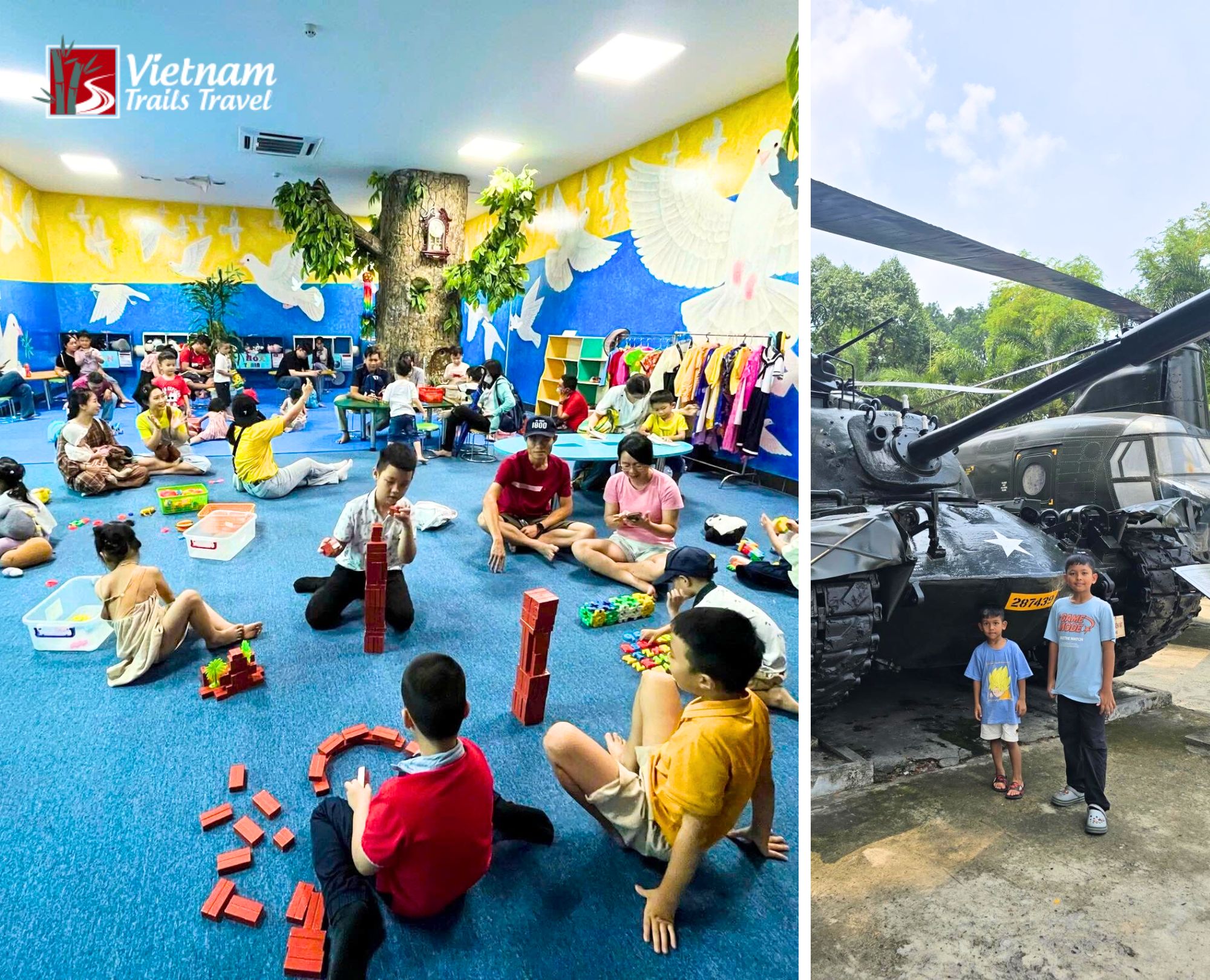
Teenagers who have studied the period at school generally handle the material and often take more from it than their parents expect, though a conversation afterwards helps. School groups from Europe, Australia and North America visit throughout the year.
The tone inside is subdued rather than performatively solemn. Vietnamese people visit in large numbers alongside foreign tourists, and school parties are common on weekday mornings, which is another argument for the 7:30 opening slot.
14. Facilities, accessibility and photography rules
A lift serves all three museum floors, so wheelchair access indoors is workable, though the courtyard surfaces are uneven in patches and the annex has a step at the entrance. Toilets sit on the entrance level. Large bags go into free lockers near the entrance, and the café at the rear sells water, coffee and light snacks at ordinary city prices.
Photography is allowed everywhere except where signs indicate otherwise. Flash is discouraged in the photographic galleries for conservation reasons and produces poor results against the glazing anyway. There is no dress code, unlike at temples and pagodas, but the air conditioning upstairs runs cold enough that a light layer helps on a two-hour visit.
Cash in small denominations speeds up the ticket line, with 50,000 and 100,000 VND notes the easiest to break. The museum bookshop stocks English-language histories of the period, including translated Vietnamese accounts that are hard to find elsewhere.
15. Is the War Remnants Museum worth visiting?
Yes, and you should visit the War Remnants Museum first. Anyone with an interest in modern Vietnamese history should reach the museum before the Cu Chi Tunnels or the Independence Palace, because this is the site that supplies the context the others assume. Doing the tunnels first inverts the natural order and turns a serious subject into an obstacle course.
One caveat applies. A visit changes the mood of the day, and pairing it with a cheerful evening takes some thought. Travellers on a short break who want a light introduction to the city may prefer the Reunification Palace, which covers the end of the conflict through architecture and preserved 1970s interiors rather than photographs.
Reviews consistently mention two things: the emotional weight of the second floor, and the value of the ticket against almost any comparable institution in Southeast Asia.
Both observations are fair. The account presented here is partisan, and treating it as one carefully argued position among several is the most useful frame to carry through the gate.
16. Mistakes first-time visitors make
Reaching the museum at 10:00 is the common one, since that lands you in the middle of the coach window with queues at every panel. A second is budgeting an hour, which forces a skim of exactly the material worth reading. A third is skipping the annex, which sits to the left of the courtyard behind modest signage and holds the prison exhibit.
Scheduling matters too. Booking a Cu Chi Tunnels day trip and this visit into the same twelve hours produces fatigue rather than understanding, since the tunnels lie 70 kilometers northwest and take a half day at minimum. Two consecutive mornings work far better.
The last mistake is arriving hungry. Nothing substantial is sold inside the museum, the surrounding blocks are residential, and the nearest real food is a five-minute walk away.
17. Going with a guide or visiting on your own
Independent museum visits work well, and the recorded commentary covers most of what a general city guide would say. Roughly half the foreign visitors arrive as part of a half-day Saigon tour that also takes in the Independence Palace and Notre Dame Cathedral, which is efficient but usually allots only sixty to ninety minutes inside.
A private guide earns their fee in one specific case: if you want the Vietnamese reading of the material explained rather than presented. Guides who grew up in the south often add family context that no panel provides, and the difference in what you take away is considerable.
Groups of four or more should consider a car with a driver for the wider itinerary rather than separate rides, since the museum, the palace, the cathedral and Ben Thanh sit within a two-kilometre radius and parking is the only real difficulty.
18. Where to eat and drink nearby
The streets around the museum on Vo Van Tan and Le Quy Don hold a run of local restaurants that fill at 11:30 with office workers, which is a reliable signal. Banh mi and com tam stalls operate along Nguyen Thi Minh Khai, two minutes from the gate, and a full lunch rarely passes 80,000 VND per person.
Turtle Lake, five minutes east, is the standard evening spot for street food and iced tea. Hotel des Arts Saigon on Nguyen Thi Minh Khai runs a rooftop bar that works as a decompression stop after a heavy morning, and the coffee shops on Book Street beside the cathedral are closer to the walking route described below.
19. What to combine with your visit: a central Saigon route
The museum anchors a half-day walking route through the colonial-era centre of Ho Chi Minh City with no transport required.
| Time | Stop |
|---|---|
| 7:30 | War Remnants Museum, two hours inside |
| 10:00 | Independence Palace, 600 m southeast |
| 11:15 | Notre Dame Cathedral and Saigon Central Post Office |
| 12:00 | Lunch near Ben Thanh Market |
| 14:00 | Book Street and coffee |
| 17:00 | Rooftop or river finish |
The palace rewards the second slot, with the tanks that crashed through its gates in April 1975 parked on the lawn and the command bunker open in the basement.
The cathedral remains under restoration but photographs well from outside and the post office across the square still operates as a working branch inside its French colonial shell. Ben Thanh Market closes the loop, with the surrounding streets in District 1 holding the best lunch options on the route.
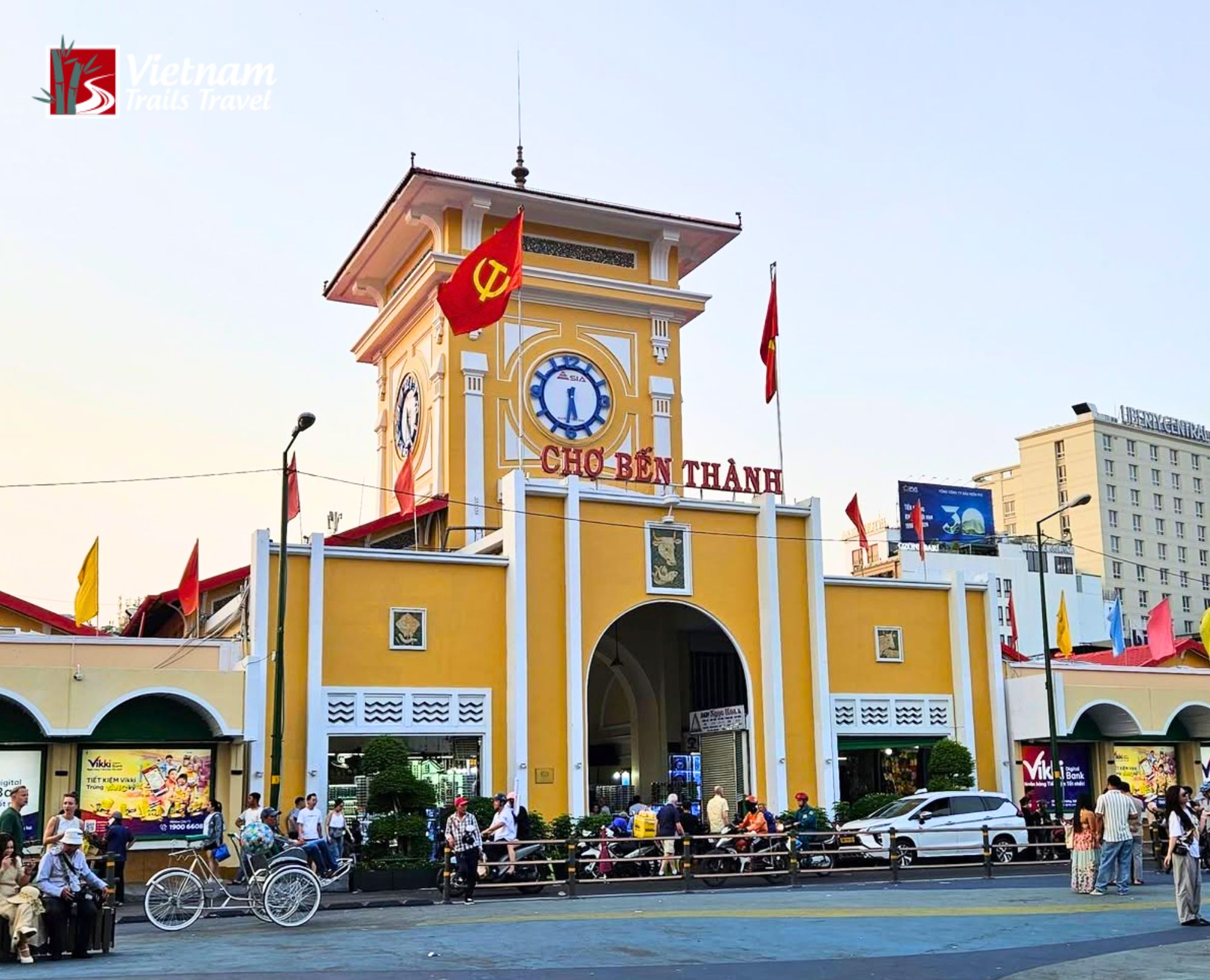
Anyone building a Ho Chi Minh City one-day itinerary should keep that sequence, since it handles the heat sensibly and puts the heaviest material in the freshest part of the morning.
Read More: Ho Chi Minh City 1 Day Tour
20. Frequently asked questions
How much is admission? 40,000 VND for adults and 20,000 VND for ages 6 to 16, with under-sixes free. Vietnamese dong is the safest payment method.
What time does it open? Daily from 7:30 to 17:30, holidays included, with ticket sales stopping about half an hour before closing.
Where is it? 28 Vo Van Tan Street at the corner of Le Quy Don, roughly 1.5 kilometres from Ben Thanh Market and 600 metres from the Independence Palace.
How long should I allow? Ninety minutes for the highlights, two hours for a standard visit, three or more hours to read everything. Two hours is the average.
Is it suitable for children? The courtyard suits all ages. The upper floor is not suitable for younger children, and families often split the visit between adults.
Do I need to book in advance? No. Tickets are sold at the gate and the queue is short at any hour.
Is there an audio guide? Yes, rented at the ticket counter in several languages for a small fee. It compensates for uneven English captions.
Can I take photographs? Yes, throughout the grounds and in most galleries. Flash is discouraged indoors.
Is it better than the Cu Chi Tunnels? They serve different purposes. This is the documentary account; the tunnels are the physical one. Visiting the galleries first makes the tunnels more legible.
How do I say the name in Vietnamese? Bao Tang Chung Tich Chien Tranh. Showing the written phrase to a driver removes any confusion over the English name.
