
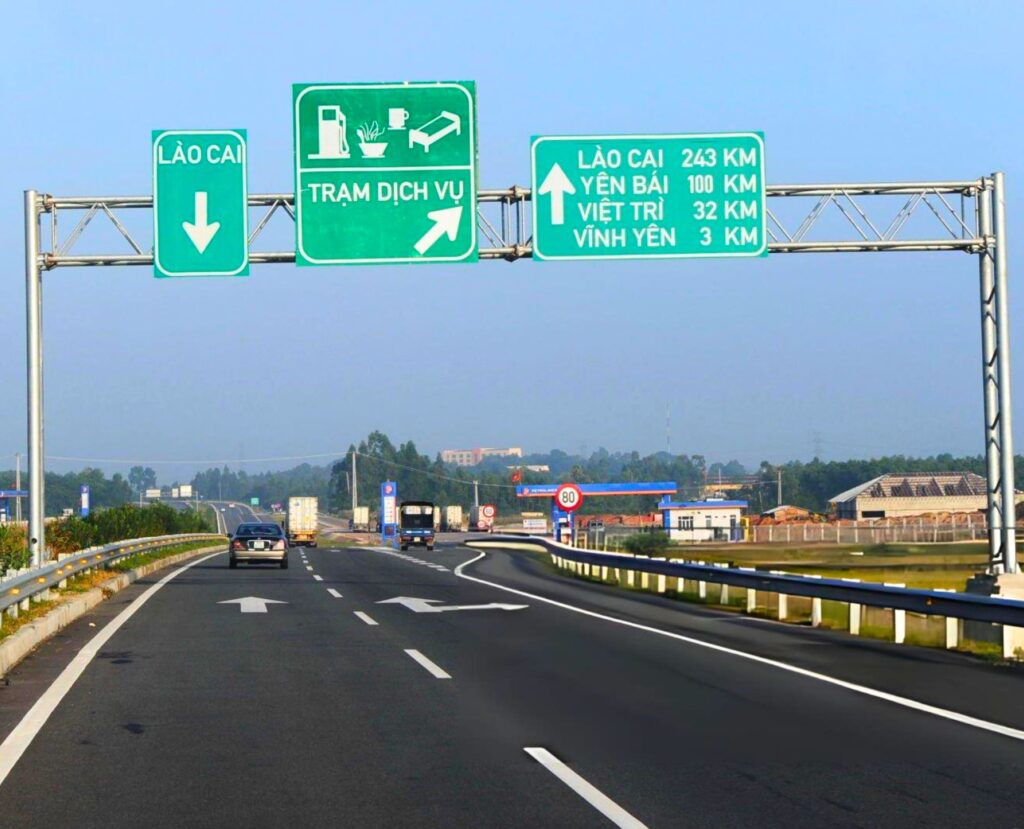
Welcome to the dynamic heart of Southeast Asia! As a premier inbound travel company based right here in Saigon, we have spent the past ten years helping international guests experience the absolute best of this beautiful country.
Whether you are sipping artisan coffee near your 5-star hotel in District 1 or planning an adventurous 2026 road trip down the breathtaking coastline, your holiday promises to be unforgettable.
However, we know the local traffic environment can look quite intimidating to newcomers. The flow of thousands of motorbikes moving alongside cars and buses operates with its own unique rhythm.
If you plan to rent a car or even just want to understand the routes your private chauffeur takes, you need to know about the traffic signs before hitting the streets. Learning how to accurately read a Vietnam road sign is the most effective way to ensure your journey remains safe, enjoyable and free of unexpected delays or fines.
To help our clients and fellow travelers navigate the roads with complete confidence, our local travel experts have compiled this comprehensive guide. We will walk you through everything you need to know about interpreting a Vietnamese street sign, so you can drive safely and focus entirely on making incredible memories.
I. Why understanding traffic signs in Vietnam is essential for your trip
For many foreign visitors, stepping into the local traffic feels like observing a highly intricate dance. While it might appear unstructured at first glance, the constant movement of vehicles is actually heavily regulated by a strict system of road signs in Vietnam. Every single Vietnam road sign plays a vital role in keeping that complex dance moving smoothly and safely.
As a driver in a new country, you will undoubtedly encounter situations that feel completely different from what you are familiar with back home. Spotting a Vietnam road sign early gives you the precious reaction time needed to adjust your speed, switch lanes safely or prepare for a busy intersection.
For solo travelers heading into the remote mountainous regions of Da Lat or along the coastal highways toward Nha Trang, recognizing an unfamiliar road signs in Vietnam quickly is essential for personal safety.
Expert Travel Tip: Even if you decide not to drive yourself, taking a few minutes to familiarize yourself with Vietnam road signs is highly helpful. It allows you to understand the specific routes your driver is taking, providing peace of mind during long scenic transfers on our curated regional tours.
When you choose to rent a car through our agency for a self-drive adventure, we always ensure you are completely comfortable with the local regulations. Failing to follow a Vietnam Road Sign can result in immediate traffic stops by local authorities which can quickly put a damper on your luxury vacation. Taking the time to learn these visual cues will help you avoid all of that, allowing you to blend right in with the local flow.
II. Exploring Road Signs in Vietnam
The local traffic management system generally aligns with international conventions, meaning the basic shapes and colors of a Vietnam road sign might look somewhat familiar.
However, their specific applications and local variations can be quite unique. The system is divided into distinct visual categories, and understanding the core rules of a Vietnamese traffic sign will make decoding them incredibly easy as you explore.
1. Prohibition Signs
The most critical category of Vietnam street signs is prohibition. A prohibition sign dictates exactly what a driver cannot do. These rules are strictly enforced by traffic police to prevent accidents and alleviate severe congestion in city centers.
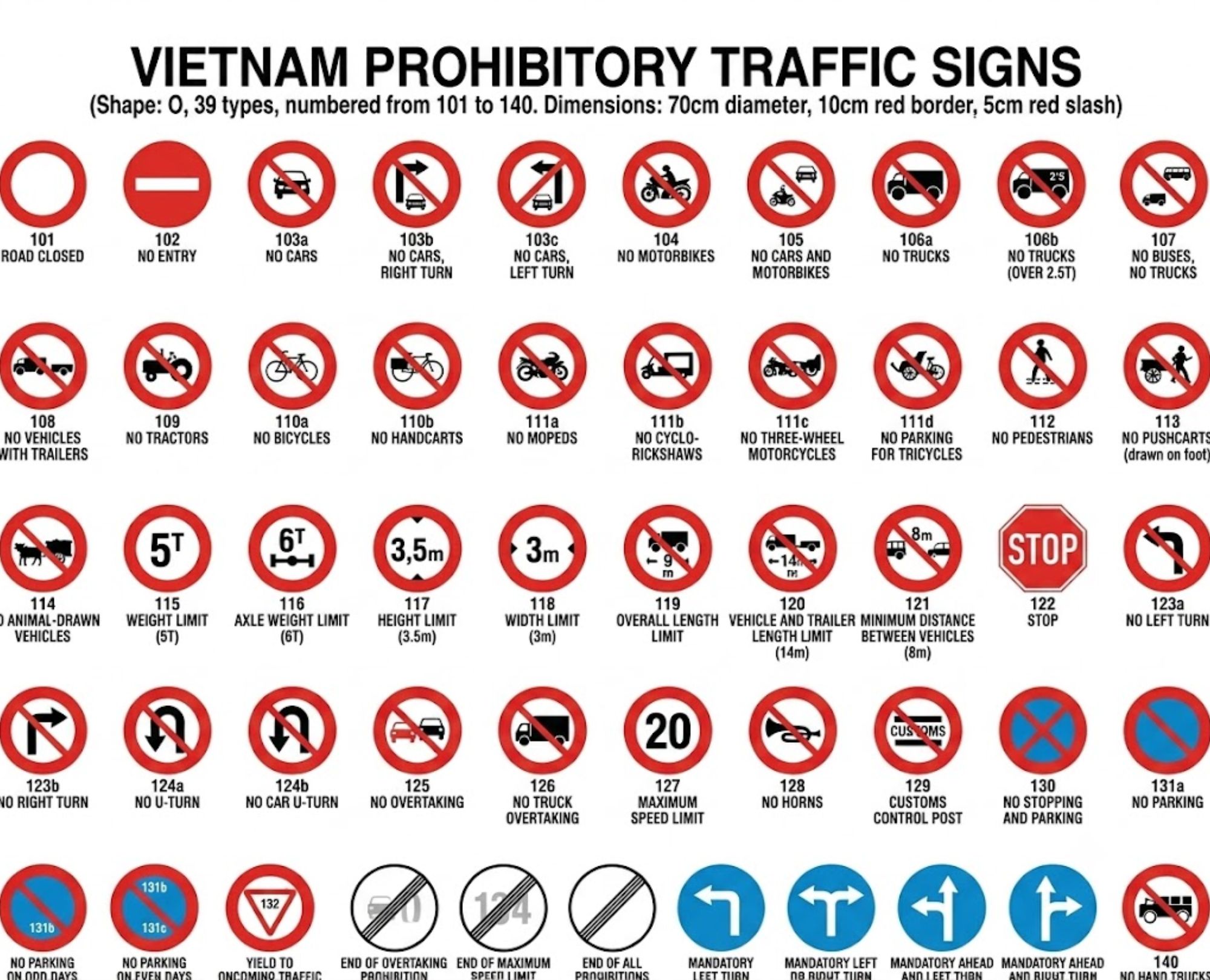
How to spot them: You can instantly recognize a prohibitory road signs in Vietnam by its bold circular shape, bright red border, and stark white background. Inside this circle, a black icon usually illustrates the banned action, often crossed out by a diagonal red line.
Key examples you will see:
- No Entry for Cars: If you see a traffic sign displaying a car with a red line slashed through it, you must find an alternate route. Entering these restricted zones is a major regulatory violation. When our clients rent a car, our integrated GPS systems help route them away from these restricted streets.
- One-Way Streets: A solid red circular Vietnam Road Sign featuring a horizontal white bar means “No Entry.” You will spot this specific Vietnamese street sign frequently in Saigon’s bustling downtown districts to manage heavy directional traffic.
- No Parking or Stopping: A blue circular traffic sign with a red border and a red cross (or single diagonal line) indicates that leaving your vehicle there will result in a ticket or towing. If you are using our self-drive service, we always provide a list of approved parking zones near major 5-star hotels to ensure your vehicle is safe.
Whenever you encounter a prohibitory Vietnam Road Sign, you must comply immediately. Ignoring this type of Vietnamese traffic sign not only risks a heavy fine but also directly endangers other road users and pedestrians.
2. Danger and Warning Signs
While prohibition markers tell you what is strictly illegal, a warning sign acts as a friendly heads-up from the highway authorities. These markers alert you to potential hazards ahead, giving you ample time to slow down, assess the environment, and proceed with caution.
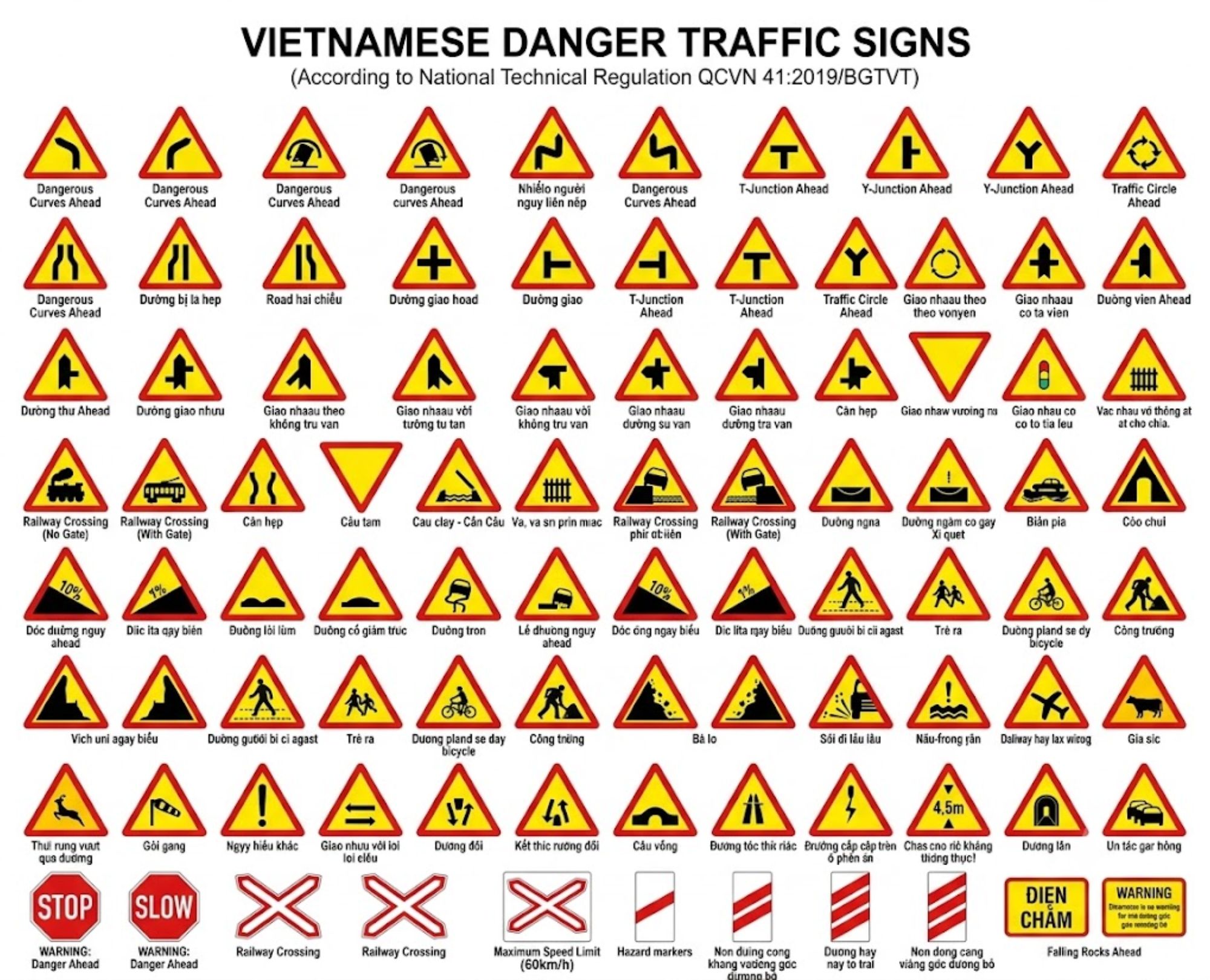
How to spot them: A standard warning sign is shaped like an equilateral triangle featuring a thick red border and a bright yellow background.
Common hazards to indicate:
- Narrowing Roads: Driving through charming rural villages, you might see a Vietnamese traffic sign showing parallel black lines pinching inward. This indicates a bottleneck or a narrow bridge approaching. Our professional tour drivers are expertly trained to handle these tight spaces smoothly.
- Pedestrian Crossings: A sign featuring a stick figure walking on a crosswalk means you should prepare to yield, especially near local schools, vibrant markets, or busy tourist hubs.
- Dangerous Curves: A sign with a twisting black arrow warns of sharp, blind corners. This is vital information if you are navigating famous, winding routes like the Hai Van Pass.
Because road conditions can change rapidly due to sudden tropical weather or active construction, paying close attention to every warning Vietnam Road Sign ensures you are never caught off guard. It is one of the easiest ways to guarantee your travel safety.
3. Mandatory Signs
Instead of restricting your actions, a mandatory sign tells you exactly what you are legally required to do. These firm commands help organize the chaotic flow of massive intersections and multi-lane highways, keeping everyone moving in harmony.
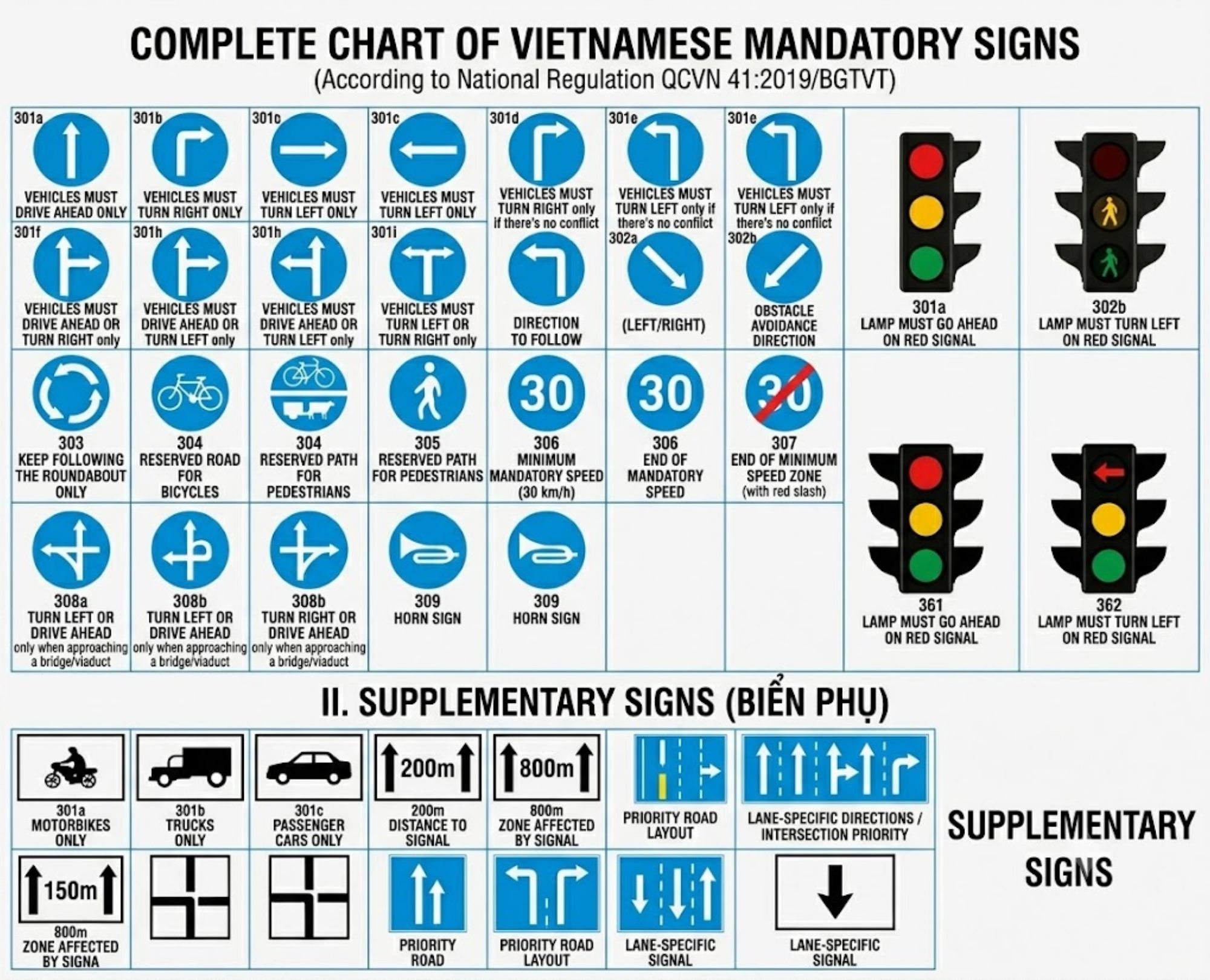
How to spot them: A mandatory sign is perfectly round, featuring a vibrant, solid blue background with crisp white icons or arrows.
What they command the user to do:
- Directional Flow (Signs 301a-301i): Placed near intersections, this blue sign features arrows pointing straight, left, or right. You are legally required to move only in the indicated direction.
- Vehicle-Specific Lanes: In major cities, a Vietnam Road Sign will often display a picture of a car or a motorbike to dictate which lane you must use. Drifting into a motorbike lane while driving a car is a very common mistake for foreign visitors. When you pick up your rental vehicle from us, we always emphasize the importance of following this specific traffic signs in Vietnam to avoid unnecessary traffic stops.
- Roundabout Circulation: A sign with arrows moving in a circle means you must enter the roundabout and yield to the traffic that is already circulating inside.
Obeying a mandatory Vietnam Road Sign keeps you safely within the predictable, legal flow of local traffic, making your driving experience significantly less stressful.
4. Information and Guide Signs
If you are embarking on a self-drive adventure, an guide signs in Vietnam is your best friend. These markers provide essential details about your route, upcoming towns, and nearby services, acting as a visual map right outside your window.
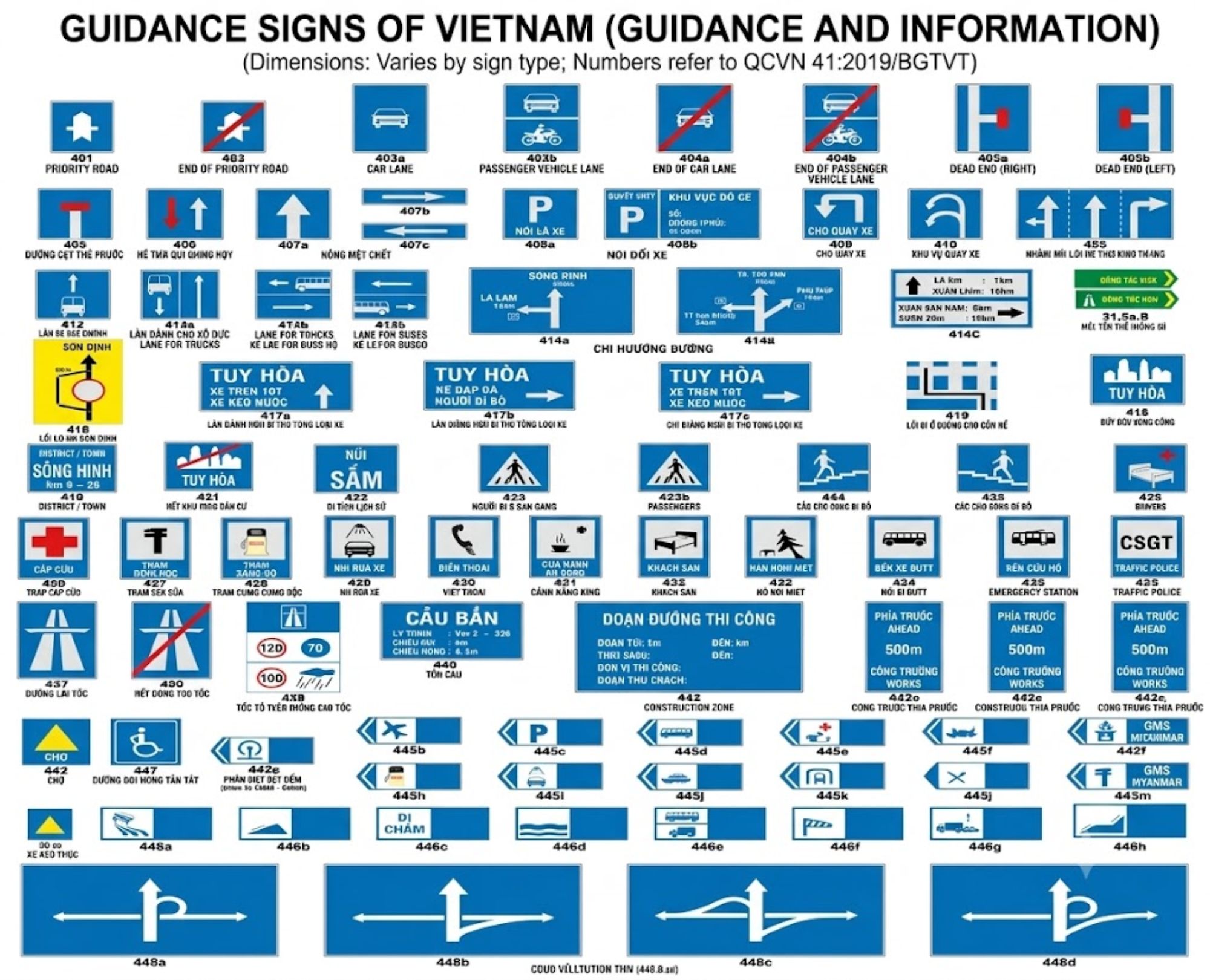
How to spot them: A guide to Vietnam road signs is usually rectangular or square, featuring a blue or green background with bright white text and symbols.
What they provide: You will look for this type of Vietnamese traffic sign to locate gas stations, scenic rest stops, international hospitals, and famous tourist attractions.
Language variations: On major expressways and near major cities, a sign is often written in both Vietnamese and English to accommodate international visitors. However, as you travel deeper into the country on provincial roads, the information on a sign might be solely in the local language. Relying on the standard universal icons printed on the Vietnam traffic sign will help you easily find what you need, even when you cannot read the text.
Mastering Speed Limits and the Expressway Vietnam Road Sign
Managing your speed is perhaps the most challenging aspect of driving in a new country. The legal limit can fluctuate significantly depending on the zone you are passing through, and missing a speed-related Vietnam road sign can be an expensive mistake.
1. Decoding Local Speed Restrictions
You must constantly scan the roadside for a Vietnam Road Sign dictating the appropriate pace of traffic. There are several variations that solo travelers and groups who rent a car need to memorize:
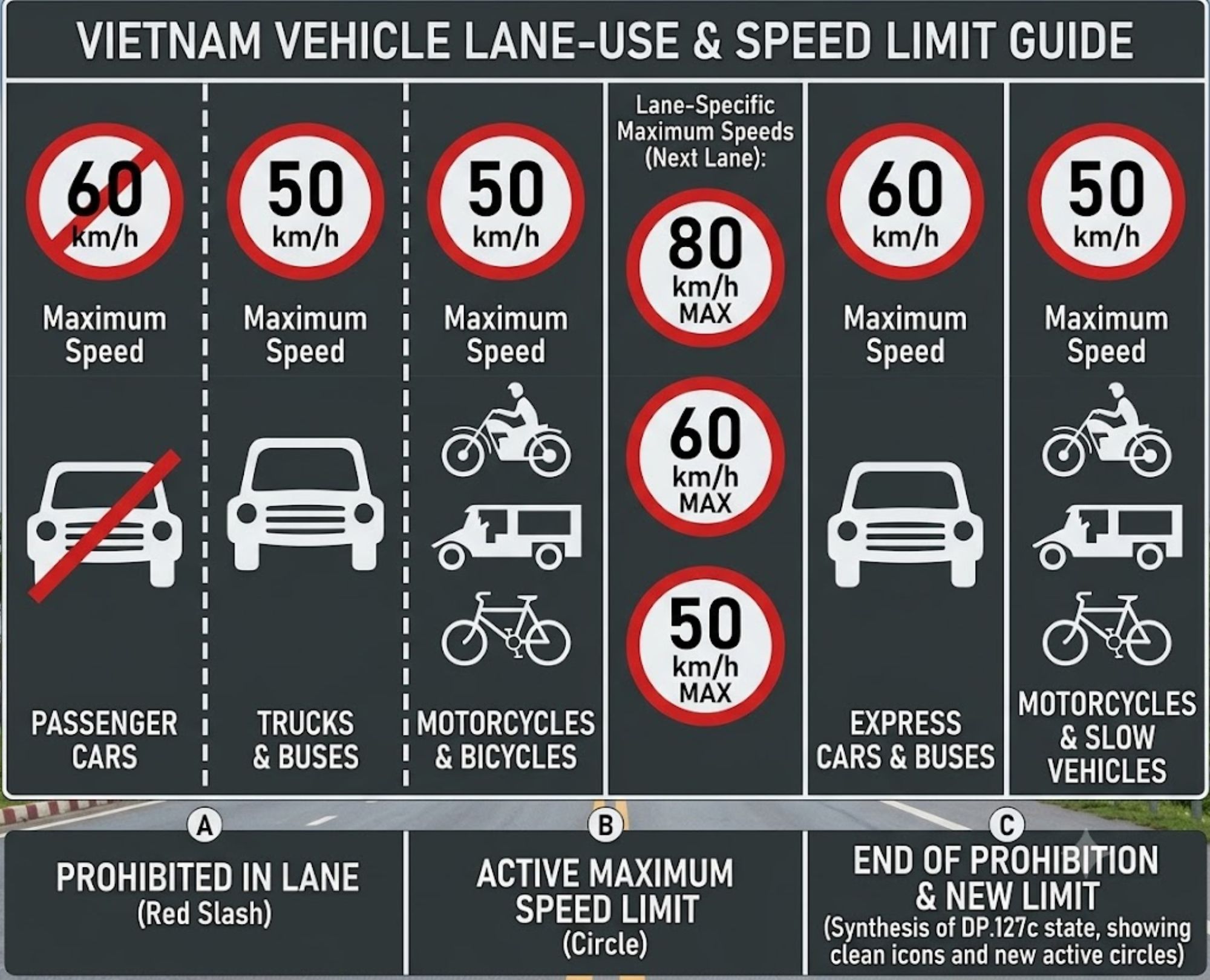
Maximum Allowed Speed (Sign P.127): This classic Vietnamese street sign features a red border, a white background, and a bold black number. If the Vietnam road sign says “60”, that is your absolute limit in kilometers per hour.
Nighttime Limits (Sign P.127a): Because visibility is drastically reduced after dark, a specific rectangular Vietnam Road Sign with a black background and red numbers will indicate the maximum speed allowed during specific evening hours.
Speed by Lane (Signs P.127b & P.127c): On wide, modern boulevards, a blue rectangular traffic signs in Vietnam will display different speed limits for different lanes. Sometimes, this Vietnam road sign also specifies exactly which vehicles are allowed in those lanes.
2. Navigating Modern Expressways
By 2026, the country’s highway infrastructure will have expanded dramatically, connecting distant provinces faster than ever before. Driving on these high-speed roads requires reading a specialized road sign.
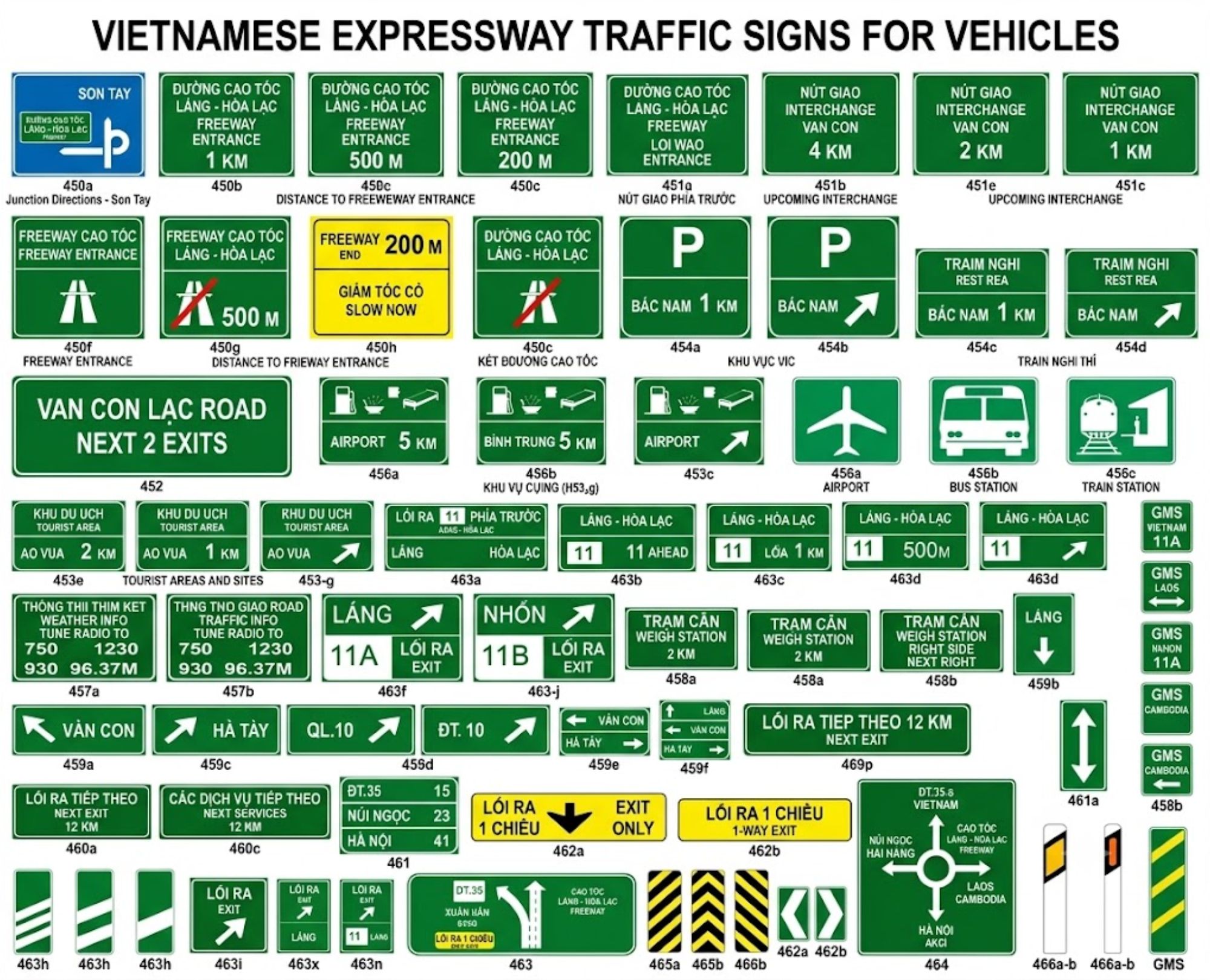
An expressways sign is distinctively large, rectangular, and bright green. It provides crucial data for safe high-speed travel:
Dual Limits: A highway sign often displays a minimum speed (inside a blue circle) and a maximum speed (inside a red circle). You must maintain a steady pace between these two numbers. If the idea of managing highway speeds feels daunting, booking one of our private chauffeur services allows you to relax while a local expert handles the drive.
Safe Distances: You will frequently pass a Vietnamese road sign reminding you to keep a safe following distance of 50m, 100m, or 200m from the vehicle ahead to prevent collisions.
Exit Approaches: A green sign will warn you 1km or 2km in advance of your required exit, giving you plenty of time to safely merge and change lanes.
Because everything moves much faster on the expressway, identifying a Vietnamese street sign from a distance is a skill you will quickly develop.
3. Supplementary Signs
Sometimes, a primary Vietnam road sign simply does not provide the complete picture. That is where auxiliary signs come into play. An supplementary sign is a smaller, rectangular board placed directly beneath the main sign to offer vital context and exceptions to the rule.
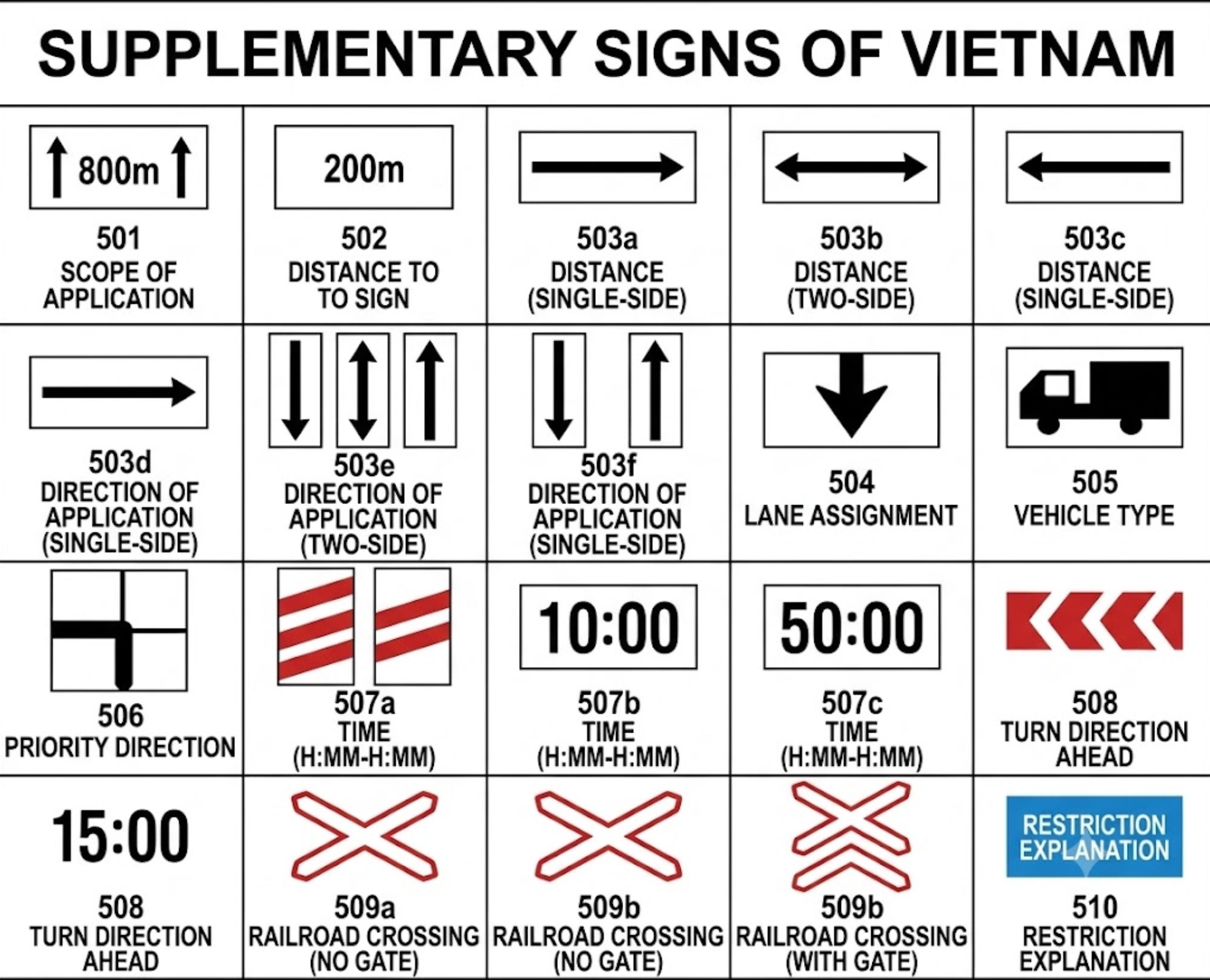
How they work: This supplemental Vietnamese street sign might indicate the exact distance until a specific hazard begins, the precise hours a parking ban is enforced, or which vehicle classes are completely exempt from a prohibition.
The S507 Turning Sign: A very common auxiliary Vietnam road sign you will see at complex intersections is the S507. It features a bold, zigzagging black arrow. This sign clarifies the specific “right of way” path at a confusing junction, helping you avoid cutting off local traffic.
As a general rule, never ignore a small Vietnam road sign attached underneath a larger one. It almost always contains the specific exception or important detail that applies to your current driving situation.
Final Thoughts
Driving in a foreign environment requires focus, adaptability, and a good sense of humor. Traffic may seem aggressive at times, but it is actually highly cooperative once you understand the rhythm. Maintain a steady speed, signal your intentions early, and trust that a Vietnam road sign is guiding the general flow of motorbikes and cars around you.
While relying on a physical Vietnamese road sign is mandatory, combining your knowledge with a modern GPS application keeps you updated on real-time congestion and temporary route changes. (It is worth noting that all our premium rental vehicles come pre-equipped with updated local navigation systems to assist you). Watch out for temporary signs near construction zones, as a temporary sign will immediately override standard rules.
We understand that studying every single Vietnam traffic sign might not sound like the most relaxing way to spend your luxury vacation. That is exactly why our inbound travel agency offers a variety of premium transportation solutions tailored to your specific comfort level.
Whether you are an adventurous soul looking to rent a car and navigate every sign yourself, or you prefer to hire an English-speaking driver who knows every Vietnamese street sign intuitively, we have you covered.
Your safety, comfort, and enjoyment are our top priorities. Having a basic understanding of a Vietnam road sign will undoubtedly enrich your travel experience, giving you a deeper appreciation for the structured, vibrant rhythm of daily life here.
