
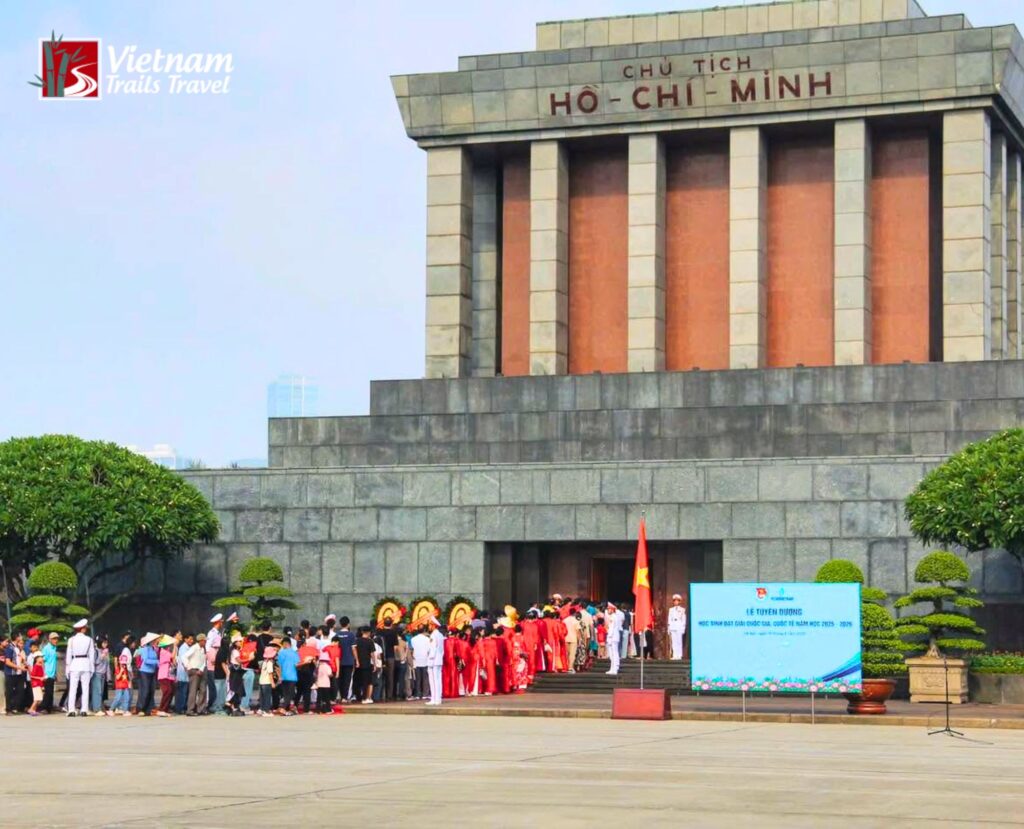
The Ho Chi Minh Mausoleum is located on Hung Vuong Street in Hanoi, and it holds the embalmed body of President Ho Chi Minh, on public display since 1975. Entry is free of charge for every visitor, Vietnamese and foreign.
The building opens on Tuesday, Wednesday, Thursday, Saturday and Sunday mornings only, with Monday and Friday closed all year. Each autumn it also shuts for scheduled preservation work.
For 2026, the Mausoleum Management Board announced maintenance from 4 September to 2 November, with visits resuming on 3 November, so anyone travelling to Vietnam during those weeks should plan around it.
A visit takes far less time than most people expect. You will spend forty minutes to an hour in the queue and security line, then roughly one minute walking past the glass sarcophagus.
The rest of the morning goes to the wider complex behind the building, which holds the Presidential Palace grounds, the stilt house, the museum and the One Pillar Pagoda. Most travel agencies in Hanoi allow three to four hours for the whole site.
1. Who was President Ho Chi Minh?
Ho Chi Minh was the founding president of the Democratic Republic of Vietnam and the central figure of the country’s independence movement. He was born on 19 May 1890 in Kim Lien village, Nam Dan district, Nghe An province, and his birth name was Nguyen Sinh Cung. His father was a Confucian scholar who refused a comfortable position in the colonial administration, and that background shaped much of what followed.
At the age of 21, he left Vietnam from Nha Rong Wharf in Saigon, working as a kitchen hand on a French steamship. The next three decades took him to France, the United States, Britain, the Soviet Union, China and Thailand.
He worked as a cook, a photo retoucher and a laundry assistant while writing for socialist newspapers in Paris under the name Nguyen Ai Quoc, meaning Nguyen the Patriot.
In 1919, he submitted a petition to the Versailles peace conference asking for basic civil rights for the Vietnamese, and the delegates ignored it. The following year he became a founding member of the French Communist Party.
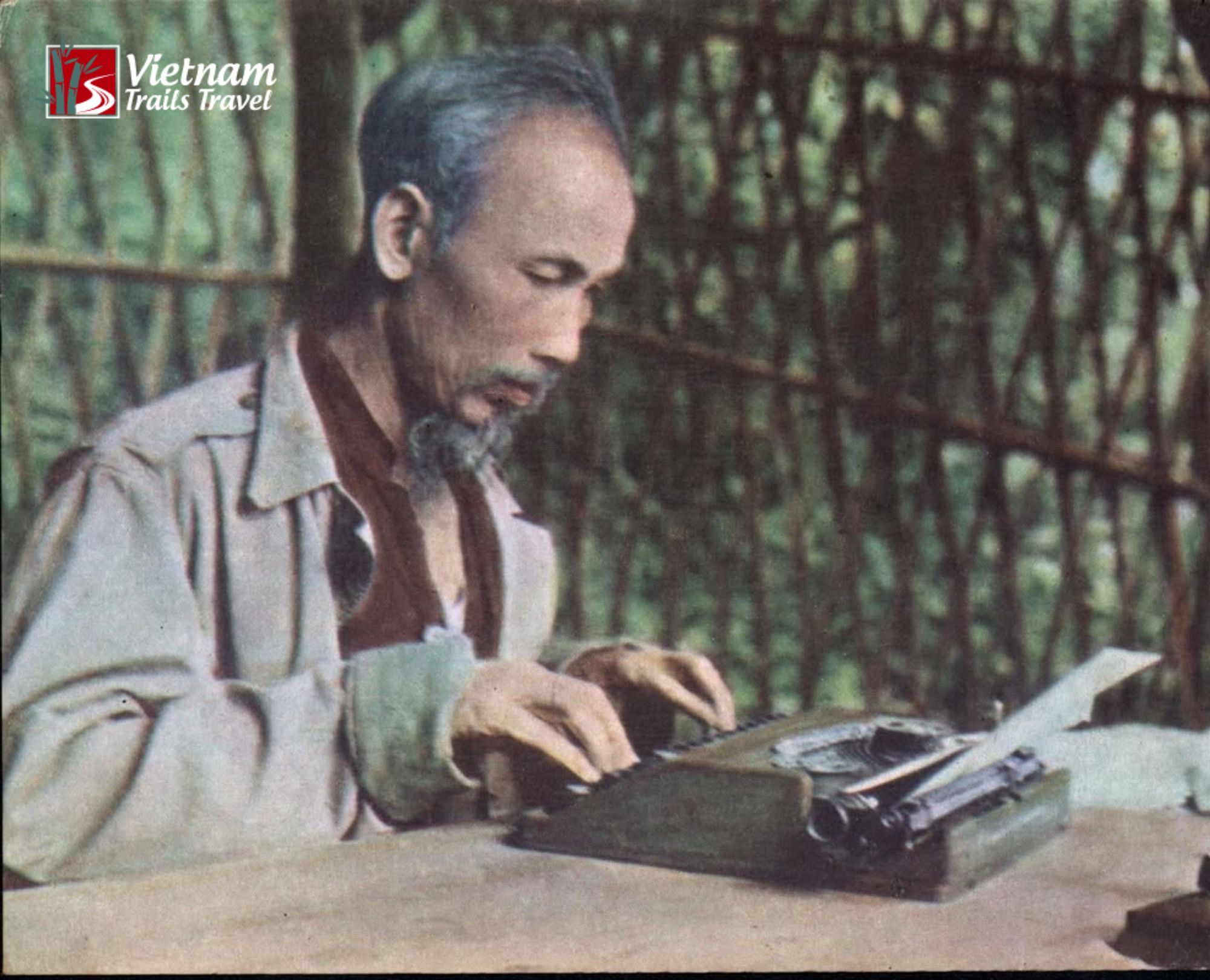
He returned home in 1941 after thirty years abroad, crossing the border into Cao Bang province and setting up base in the caves at Pac Bo. That year he founded the Viet Minh, the independence front that would lead the struggle against French and Japanese forces, and soon afterwards he adopted the name Ho Chi Minh, which translates roughly as bringer of light.
The August Revolution of 1945 put the Viet Minh in control of Hanoi, and on 2 September that year he read the Declaration of Independence to a crowd of several hundred thousand on the square that now carries the mausoleum.
He served as president from 1945 until his death on 2 September 1969, through the war against France and the first years of the American war. Vietnamese people call him Bac Ho, or Uncle Ho, a form of address that says a great deal about how he is remembered.
His personal habits are as much a part of the story as the politics. He wore rubber sandals cut from old tyres, lived in a wooden stilt house rather than the palace available to him, and left behind almost no possessions.
UNESCO marked the centenary of his birth in 1990 with a resolution recognising him as a national liberation hero and a figure of cultural importance. Understanding that reputation makes the queue outside the memorial far easier to read.
2. Why the mausoleum matters in Vietnam
The Ho Chi Minh Mausoleum in Hanoi has long been the ceremonial centre of Vietnam, not simply a sightseeing stop. The square it faces is where President Ho Chi Minh proclaimed the Declaration of Independence on 2 September 1945, an event that founded the Democratic Republic of Vietnam. That same date became National Day, and the same date in 1969 was the day President Ho Chi Minh passed away at the age of 79.
Millions of Vietnamese travel to Hanoi from every province to pay respects to President Ho Chi Minh, the leader the country still calls Uncle Ho. Among them are schoolchildren in uniform, war veterans wearing their medals, and families making the trip once in a lifetime.
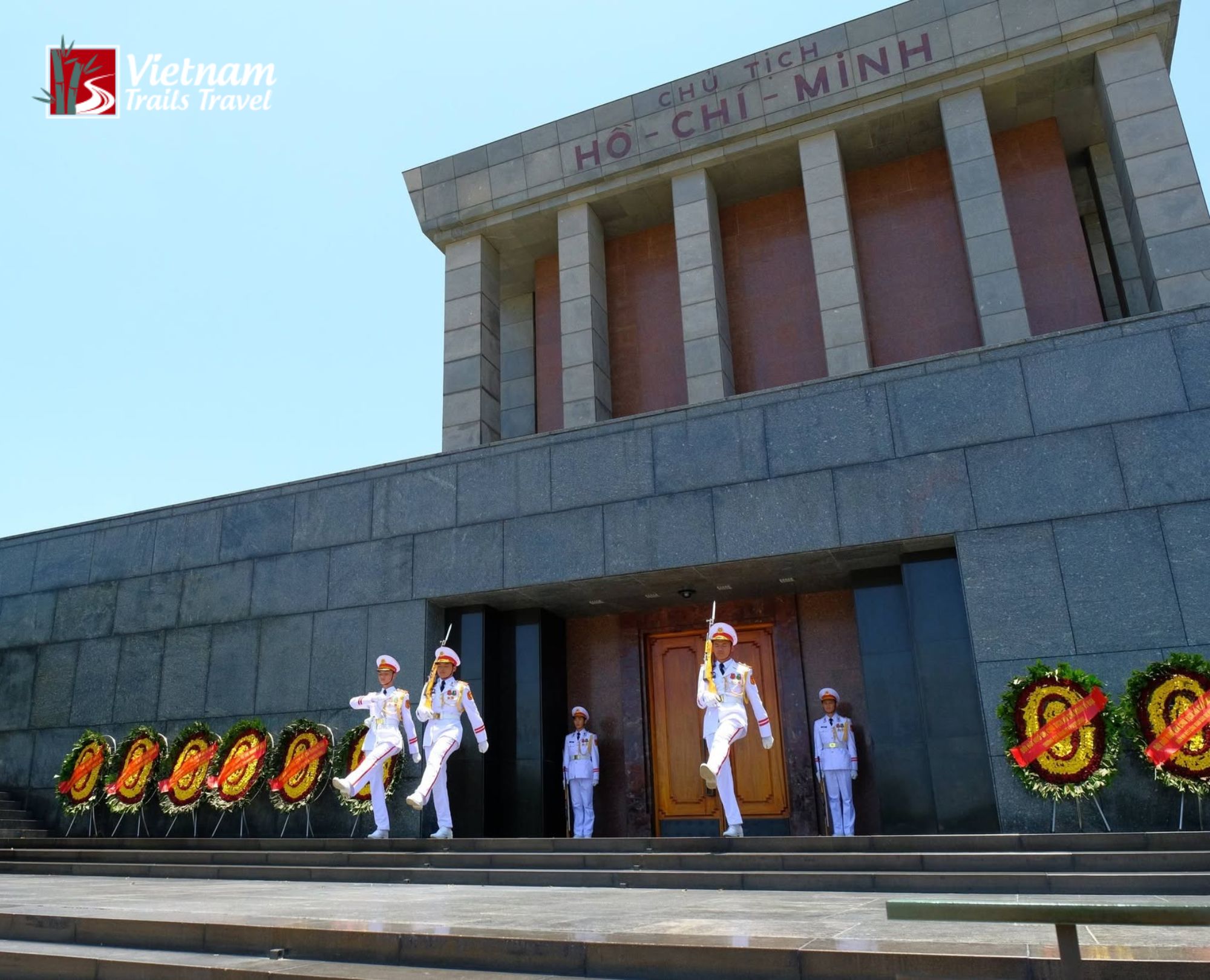
International visitors often arrive expecting a museum experience and find something closer to a pilgrimage. Understanding that difference shapes the whole visit. The silence, the strict queue and the honour guard are not tourist theatre; they reflect how the site functions for the Vietnamese people who built it.
The significance of the mausoleum also explains its rules. Photography, talking and casual behaviour are treated as disrespectful, and the guards enforce that without exception.
3. History: from 1969 to the 1975 inauguration
President Ho Chi Minh’s will asked for cremation and for his ashes to be placed on three hills in the north, centre and south of Vietnam. The Politburo decided otherwise. Following President Ho Chi Minh’s passing on 2 September 1969, the leadership chose to preserve his body and enshrine it in a permanent memorial so that people from every region could see him.
Specialists from the Soviet Union worked with Vietnamese doctors on the embalming during the war years, and the body was moved several times between secret locations in the mountains north of Hanoi to keep it safe from bombing.
Construction of the mausoleum of Ho Chi Minh began on 2 September 1973, four years to the day after President Ho Chi Minh passed away. The main structure was completed in the middle of 1975, and the mausoleum was inaugurated on 29 August 1975, a few months after national reunification.
Materials came from across the country, which was a deliberate political statement. Stone arrived from Cao Bang, Nghe An, Thanh Hoa and the marble quarries near Da Nang.
Timber for the roughly two hundred sets of doors was sent from the south, the Central Highlands and the Truong Son range. Sand came from rivers in Son La and Thanh Hoa. Tens of thousands of people contributed labour, and plants from every province were brought to the gardens surrounding the mausoleum.
Since then, the site has been managed by a dedicated military command. Preservation of Ho Chi Minh’s embalmed body continues under a joint Vietnamese and Russian scientific programme, which is the reason for the annual closure.
4. Architecture of Ho Chi Minh Mausoleum
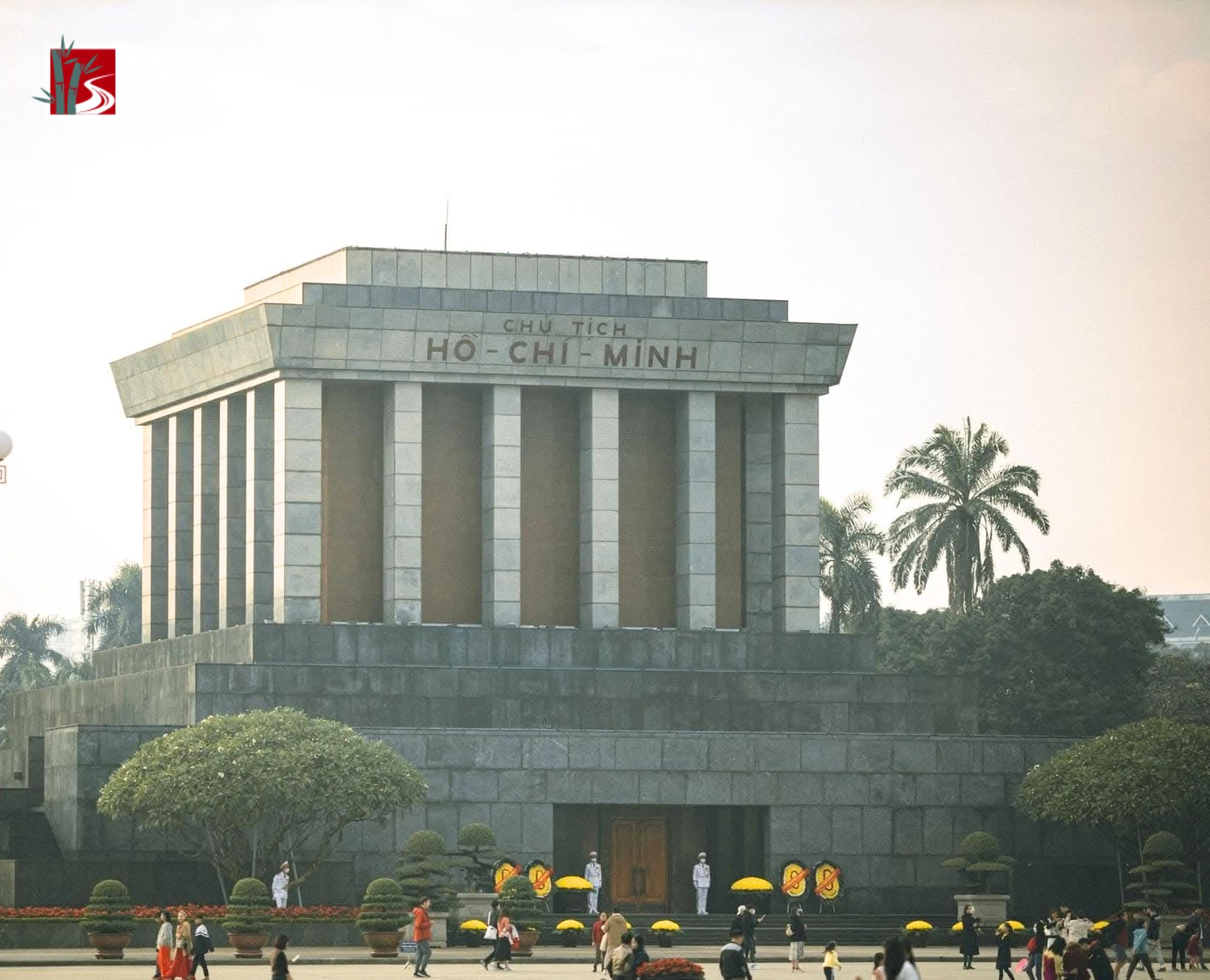
The design drew inspiration from Lenin’s mausoleum in Moscow, then adapted the form to Vietnamese taste. The result is a square granite block about 21.6 metres high and 41.2 metres wide.
The mausoleum is designed in three tiers, and architects described the profile as a lotus flower rising from the water. Its sloping upper roof borrows from traditional communal house lines rather than Soviet geometry. Two rows of square columns run along the front of the mausoleum and carry the upper tier.
Across the facade, in dark red stone, sit the words CHỦ TỊCH HỒ CHÍ MINH. The lobby inside is faced with pink-and-red-veined granite and carries his best-known sentence about independence and freedom in gilded lettering, together with his signature.
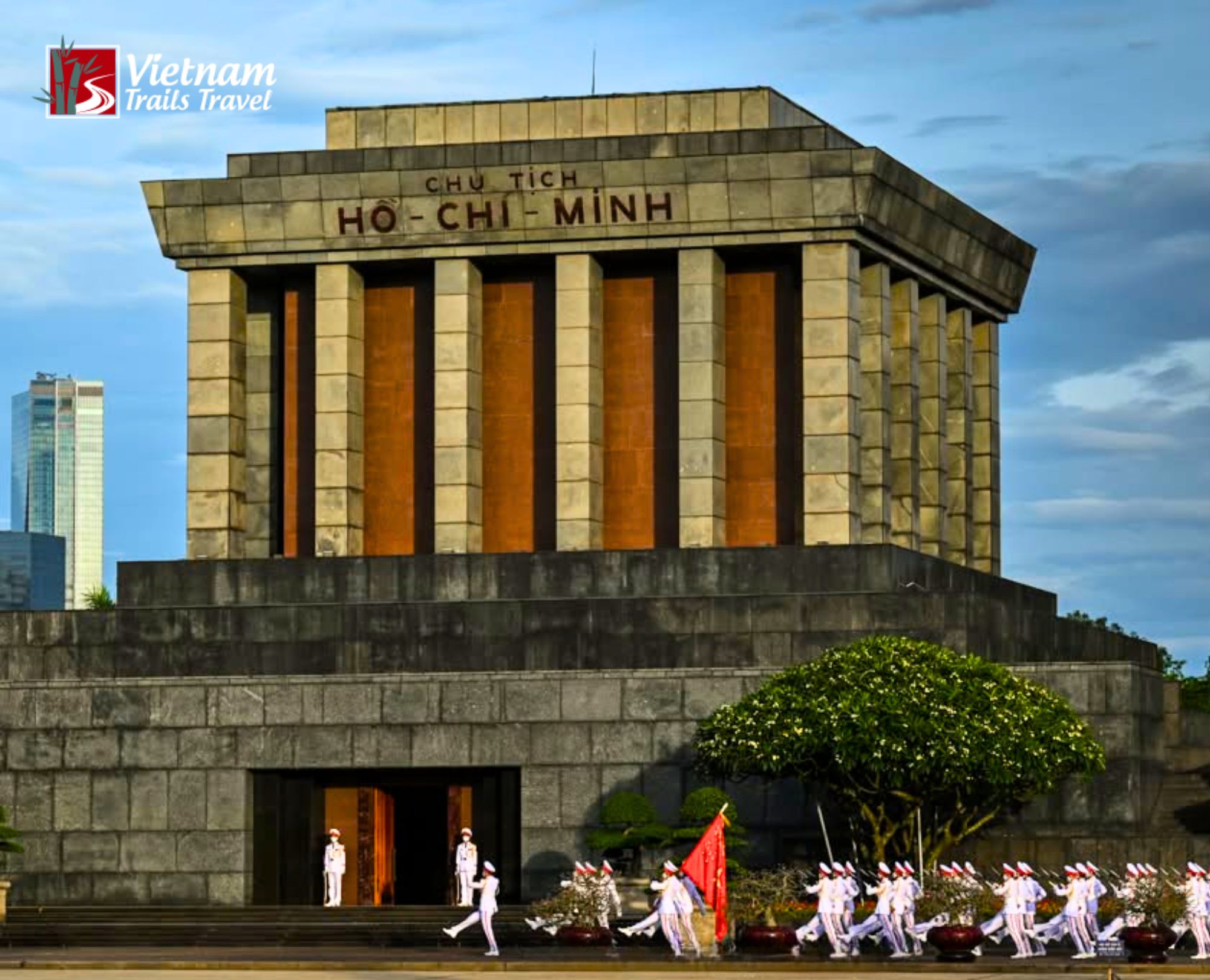
Although it was inspired by Lenin’s mausoleum, the architecture of the Ho Chi Minh mausoleum is noticeably lighter and more open than its Moscow reference, and the two hundred sets of doors in the mausoleum, cut from precious hardwood, give the interior a warmth that visitors rarely expect from the exterior.
One of the quieter pleasures of the mausoleum is its surrounding scenery. The lawns are cut in sharp bands of green, and the gardens hold around 250 plant species sent from every corner of Vietnam, including a bodhi tree gifted by India and mangrove and coconut species from the Mekong Delta.
Bamboo from the northern midlands lines several of the paths. The whole ensemble has become a historical symbol of Hanoi that appears on stamps, banknotes and school textbooks.
5. Ho Chi Minh Mausoleum opening hours
The opening hours are short, seasonal, and easy to get wrong. Two schedules apply through the year.
| Period | Tue, Wed, Thu | Sat, Sun and public holidays |
|---|---|---|
| Summer (1 April to 31 October) | 07:30 to 10:30 | 07:30 to 11:00 |
| Winter (1 November to 31 March) | 08:00 to 11:00 | 08:00 to 11:30 |
The mausoleum is open on five mornings a week, and Monday and Friday are closed days all year. The exception is when 19 May, which is Ho Chi Minh’s birthday, 2 September, or the first day of Lunar New Year falls on one of those two days; a special opening is normally announced for those dates.
The annual maintenance closure is the detail that catches most itineraries. Work takes place for roughly two months in the autumn, and the exact window is published each year.
In 2026, the mausoleum is closed to visitors from 4 September to 2 November, and it reopens on 3 November. Ba Dinh Square, the Presidential Palace site and the museum generally continue to operate during that period, subject to notices on the day.
Last entry is strictly enforced. When the queue is cut off, it is cut off, and no amount of negotiation reopens it. Aim to join the line thirty minutes before opening on a weekday and at least an hour ahead on a Sunday.
Read more: Hanoi Travel Guide 2026
6. Ho Chi Minh Mausoleum tickets and entrance fee
There are no Ho Chi Minh Mausoleum tickets to buy. Ho Chi Minh Mausoleum is free of charge for Vietnamese citizens and foreign visitors alike; there is no booking system, and no agency can sell you a skip-the-line pass, because none exists. Any operator advertising a paid Ho Chi Minh Mausoleum entrance fee is charging for transport and a guide, not for admission.
Other sites in the complex do charge, and the amounts are small. The Presidential Palace historical site, which covers the grounds, House 54 and Ho Chi Minh’s stilt house, costs 40,000 VND per foreign visitor, around 1.60 USD.
The Ho Chi Minh Museum charges a similar 40,000 VND. The One Pillar Pagoda and the square itself are free. These figures are revised occasionally, so treat them as a guide rather than a guarantee.
One more cost is worth budgeting. Bags, cameras and anything larger than a phone must go into the deposit counter near the entrance, and a small handling charge sometimes applies. Cash in small notes is easier than cards throughout the complex, as it is in most of Hanoi.
7. Ho Chi Minh Mausoleum dress code
The Ho Chi Minh Mausoleum dress code is conservative and enforced at the gate. Shoulders and knees must be covered, which rules out vests, singlets, crop tops, short shorts, short skirts and beachwear.
Trousers, long shorts that reach the knee, midi skirts and any shirt with sleeves are all acceptable. Sandals are fine, flip-flops are usually tolerated, and there is no requirement for formal clothing.
Hats and sunglasses come off before you reach the building. Guards will also ask you to take your hands out of your pockets, uncross your arms and remove anything slung across your chest. Nothing about this is negotiable, and the staff is firm but polite about it.
If the guards judge an outfit unsuitable, you will be turned away at the screening point rather than partway through the queue, which means a wasted morning. Hanoi summers are hot and the temptation to dress light is strong, so the practical answer is to wear long, loose cotton trousers and a plain T-shirt and to carry a scarf if your top is sleeveless. Visitors travelling straight from Ha Long Bay or Sapa sometimes arrive in trekking gear, and that passes without difficulty.
8. Ho Chi Minh Mausoleum rules for the best experience
A short list of Ho Chi Minh Mausoleum rules governs behaviour once you are inside the grounds. Photography and filming are banned anywhere near the building or in the viewing chamber, and phones must be switched off, not merely silenced. Talking is not allowed in the viewing chamber. You walk in two single files, you keep moving, and you do not stop to look longer.
Cameras, backpacks, food, drinks, lighters and large bags go to the deposit counter on the western side of the complex before you join the queue. A metal detector and a bag search follow. Smoking is prohibited throughout, and children need to stay with an adult at all times.
The final rule is the one visitors forget: the whole procession is a mark of respect, so hands stay out of pockets and arms stay uncrossed from the moment you pass the guard post. Soldiers positioned every few metres along the route will correct anyone who slips, with a gesture rather than a word.
9. Ho Chi Minh Mausoleum entrance, security and the queue
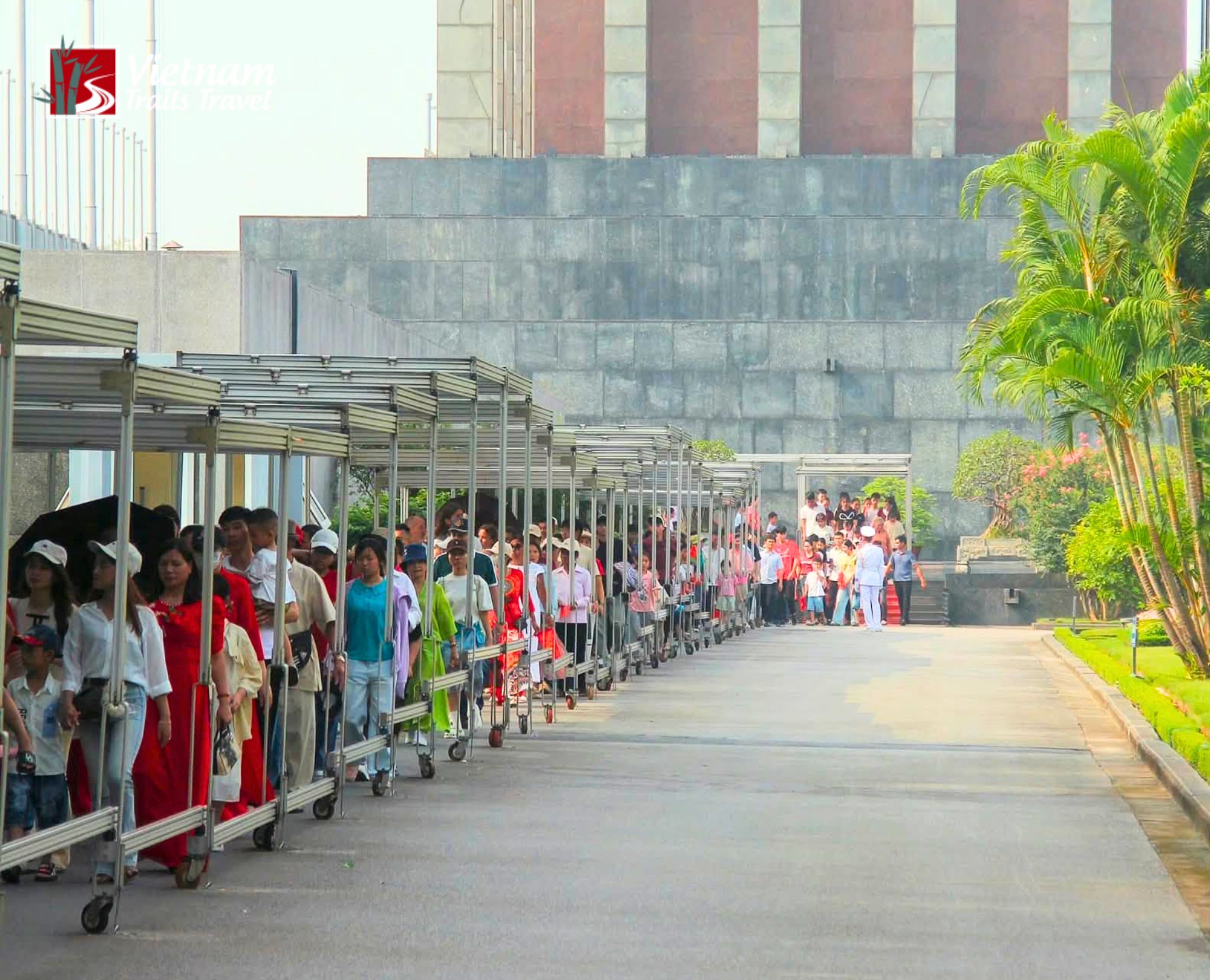
The visitor entrance is not at the front of the mausoleum. Queueing begins on Ngoc Ha Street, near the junction with Ong Ich Khiem, on the western side of the complex, and the line then moves through the deposit counter and the security check before curving around to the northern face of the building. Signage in English is limited, so it helps to look for the crowd rather than a sign.
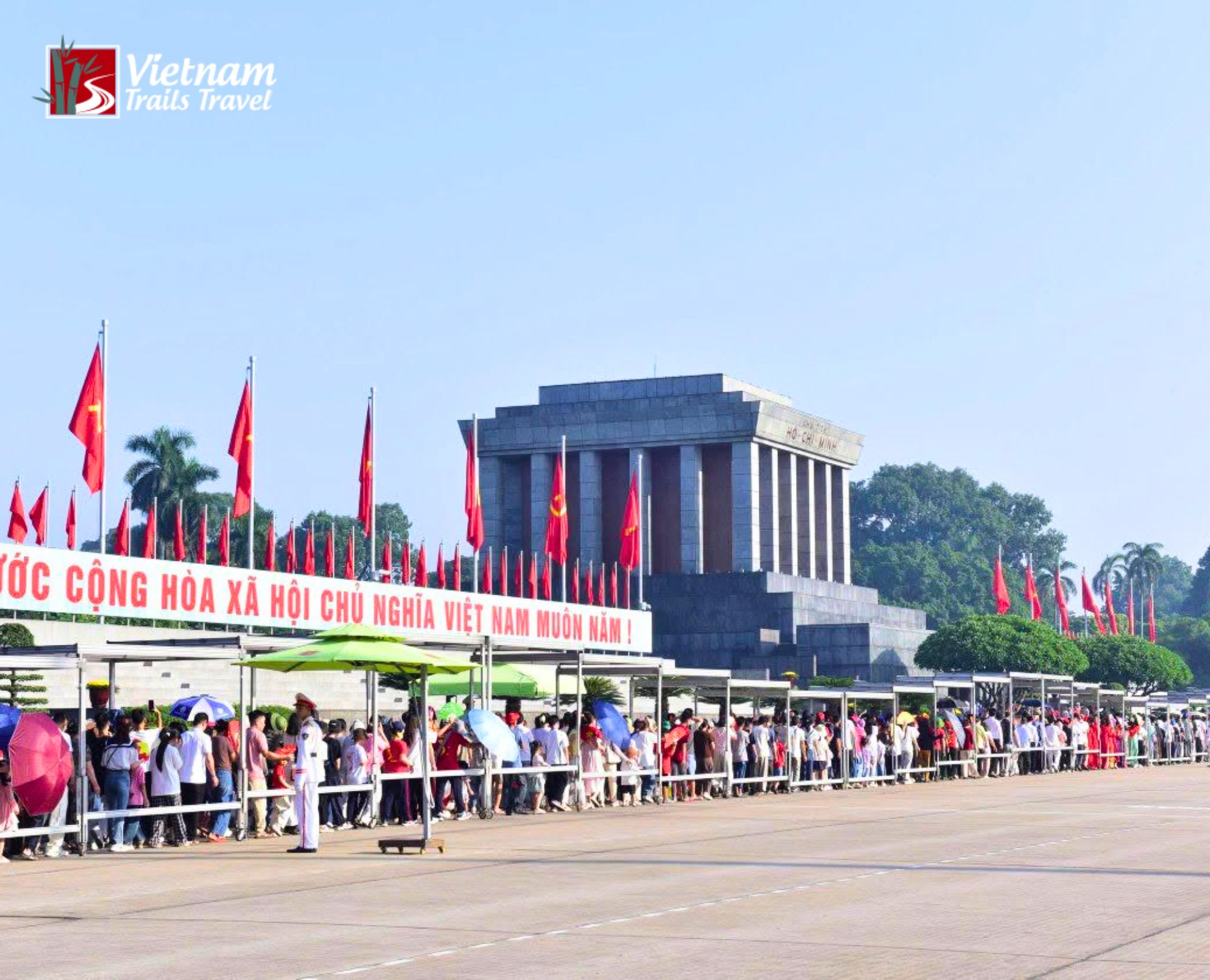
Vietnamese groups and foreign visitors join the same queue, although delegations and veterans’ groups are sometimes given priority. The wait typically runs thirty to sixty minutes on a weekday morning and considerably longer on Sundays, during Tet and around 19 May and 2 September. Under the trees the line is shaded for most of its length, which matters in June and July when the temperature passes 35 degrees.
Once the file reaches the steps, the pace changes. Entering the mausoleum happens quickly, with guards directing the flow up the stairs in a steady rhythm. There is no ticket check, no scanning and no pause.
Read more: Top 10 Luxury Hotels In Hanoi For 2026
10. Inside Ho Chi Minh Mausoleum: what you actually see
Inside the Ho Chi Minh Mausoleum, the atmosphere shifts immediately. The air is cold, kept at a low fixed temperature, and the lighting drops to a dim amber. The staircase is lined with polished stone and the only sound is footsteps.
The central room is small. Ho Chi Minh’s body lies in a glass sarcophagus, dressed in a plain khaki suit, hands resting at his sides, lit softly from above. Four soldiers in white dress uniform stand at the corners of the platform, one guard inside the room at each post, motionless throughout. Visitors walk a U-shaped path along three sides of the platform and then out, and the whole passage takes about sixty to ninety seconds.
The brevity surprises people. What lingers is usually not the sight itself but the reaction of the Vietnamese visitors around you, many of whom are visibly moved. Photography inside the mausoleum is impossible in any case, so the memory is all you take out.
The exit brings you into the gardens at the rear, which is where the second half of the morning begins.
11. The rest of the Ho Chi Minh complex
The path from the exit leads directly into the grounds where Ho Chi Minh lived and worked for the last fifteen years of his life, and most of the interesting material sits here rather than in the memorial itself.
11.1 The Presidential Palace and House 54
The mustard-yellow Presidential Palace was built between 1900 and 1906 as the residence of the French Governor-General of Indochina, and guidebooks still list it as Ho Chi Minh’s residence even though he never slept in it.
President Ho Chi Minh declined to live in it after 1954, considering it unsuitable for the leader of a newly independent Vietnam, and used it only for state receptions. Interiors are not open to the public, but the facade and the driveway are photogenic and the building anchors the whole site.
He moved instead into House 54, a modest electrician’s quarters beside the palace, which was Ho Chi Minh’s first residence on the grounds. His room, desk and simple furnishings remain as they were.
11.2 Ho Chi Minh’s stilt house
Uncle Ho’s stilt house is the highlight of the complex for many visitors. Built in 1958 in the style of Tay and Thai ethnic minority housing in the northern uplands, the two-storey wooden house measures about 10.5 metres long and sits beside a carp pond.
Downstairs is an open working area with a long table where the Politburo met. Upstairs are two rooms of roughly ten square metres each, a study and a bedroom, furnished with a camp bed, a typewriter, a radio and little else.
The contrast with the palace fifty metres away is the point of the display, and it does the work without commentary. Nearby stands House 67, the reinforced building where President Ho Chi Minh spent his final months and died in 1969.
11.3 Ho Chi Minh Museum
The Ho Chi Minh Museum sits at the southern edge of the complex, a large white building opened on 19 May 1990 for the centenary of his birth. Exhibits trace Ho Chi Minh’s life from his years working as a ship’s cook and photographer’s assistant in Europe through the revolutionary period to independence. The upper floor mixes documents and personal objects with abstract sculptural installations that divide opinion sharply.
Visitors to the Ho Chi Minh Mausoleum complex can learn more here in an hour than anywhere else in Hanoi about the man himself, and English labelling is reasonable, though the layout is not always obvious. The museum is closed on Monday and Friday afternoons.
11.4 One Pillar Pagoda
Directly beside the museum stands the One Pillar Pagoda, a small wooden shrine raised on a single stone column above a lotus pond. The original was built in 1049 under Emperor Ly Thai Tong, who reportedly commissioned it after a dream of the Bodhisattva Quan Am handing him a son while seated on a lotus. French troops destroyed the structure in 1954 and it was rebuilt the following year.
The shrine takes ten minutes to see, costs nothing, and is one of the oldest surviving religious structures in Hanoi. Entry to the shrine itself is up a narrow staircase and is often crowded, so patience helps.
12. How to get to Ho Chi Minh Mausoleum
Ho Chi Minh Mausoleum is centrally located, roughly 3 kilometres west of Hoan Kiem Lake and the Old Quarter, which is a ten to fifteen minute drive outside rush hour. Several options work well.
Taxis and ride-hailing apps such as Grab and Xanh SM are the simplest choice, and the fare from the Old Quarter runs about 50,000 to 80,000 VND. Ask the driver for Lang Bac or Ba Dinh Square rather than the English name, which is not always understood. Drivers cannot stop at the building itself, so expect a short walk to the mausoleum from the drop-off point on Ong Ich Khiem or Doi Can.
The route to Ho Chi Minh Mausoleum by bus is cheap and straightforward. Routes including 09, 22, 33, 45 and 50 stop within a few hundred metres of Ba Dinh Square, and a single fare costs 7,000 to 10,000 VND. The Hanoi City Tour double-decker also stops here.
Walking from the Old Quarter takes forty-five minutes through the Ba Dinh government quarter and is pleasant in cool weather, though less so in August. Cycling is possible, but parking near the Ho Chi Minh Mausoleum is restricted inside the security perimeter.
A private car with a driver remains the most comfortable way to reach the mausoleum for families and older travellers in Vietnam’s capital, particularly because the complex has a one-way flow and you exit a long way from where you entered. Most Hanoi operators bundle the mausoleum into a half-day city tour with the Temple of Literature.
Read more: Hanoi City Tour Full Day
13. Best time to visit the mausoleum
The best time to visit Ho Chi Minh Mausoleum is early morning on Tuesday, Wednesday or Thursday, which gives the shortest queue and the coolest air. Weekends bring large domestic groups, and the wait can double, so visiting the mausoleum on a weekday saves an hour of standing.
Seasonally, October to April is the most comfortable period in Hanoi, with dry days and temperatures between 17 and 27 degrees. That window overlaps with part of the maintenance closure, so check the current schedule before fixing dates. May to August is hot and humid, with afternoon storms that rarely affect a morning visit.
Two dates deserve special mention. Around 19 May and 2 September, the complex is at its most atmospheric, with ceremonies and heavy domestic attendance, but queues are very long.
The flag-raising ceremony at 06:00 in summer and 06:30 in winter, and the flag-lowering at 21:00, are free to watch from the square where President Ho Chi Minh declared independence, and each takes about half an hour. Both are worth building into the plan.
14. Ho Chi Minh Mausoleum reviews: what visitors report
Reviews of the Ho Chi Minh Mausoleum cluster around a few consistent themes, and they differ from the pattern at other Hanoi attractions. Most international travellers visiting the Ho Chi Minh Mausoleum rate the experience highly for its historical weight while noting that the actual viewing is over in about a minute, and the gap between the wait and the walk-through is the single most common comment.
Praise tends to go to the gardens, the stilt house and the changing of the guard rather than to the memorial interior. Criticism focuses on the queue length at weekends, the ban on cameras and bags, and the limited English signage.
Tourists visiting Ho Chi Minh Mausoleum after reading the rules report a smoother morning than those who arrive unprepared, which is the practical lesson from most feedback. Vietnamese visitors, by contrast, rarely comment on the wait at all.
Opinions on the museum split down the middle. Visitors who enjoy modern exhibition design find the upper floor rewarding, while those expecting a conventional chronological display often find it confusing.
15. Where to go after visiting Ho Chi Minh Mausoleum
The area repays a longer morning. Within a fifteen-minute walk, you have the Temple of Literature, Vietnam’s first university and a calmer counterpoint to the crowds around the mausoleum, and the Vietnam Military History Museum on Dien Bien Phu Street.
The Imperial Citadel of Thang Long, a UNESCO World Heritage site with excavated foundations dating to the eleventh century, is a five-minute drive east. Hoa Lo Prison and Hoan Kiem Lake sit slightly further on and combine well with lunch in Hanoi’s Old Quarter.
Quan Thanh Temple and West Lake lie north of the complex if you prefer somewhere quieter, and the small streets around Truc Bach are a good place to finish the day.
16. F&Q
Is the mausoleum free? Yes. There is no entrance fee for the mausoleum itself. Only the Presidential Palace site and the Ho Chi Minh Museum charge, at 40,000 VND each for foreign visitors.
Can I take photos? Outside on Ba Dinh Square, yes. In the viewing chamber and along the approach to it, no. Cameras and phones go into the deposit counter first.
How long does the whole visit take? Around three hours for the complex, of which one to two minutes is spent inside the mausoleum.
Do I need a guide? Not for entry, although a guide adds useful context at the stilt house and museum, where English information is thin.
Is the site wheelchair accessible? The grounds are flat and paved, but the memorial itself involves stairs, and staff assist where they can.
What if the mausoleum is shut on my dates? The exterior, Ba Dinh Square and the rest of the complex normally stay open, and the Temple of Literature, Hoa Lo Prison and the Vietnam Museum of Ethnology make good substitutes.
Should I book transport in advance? For a family or a group, yes. A private car with a driver removes the parking problem entirely and lets you start before the queue builds.
