
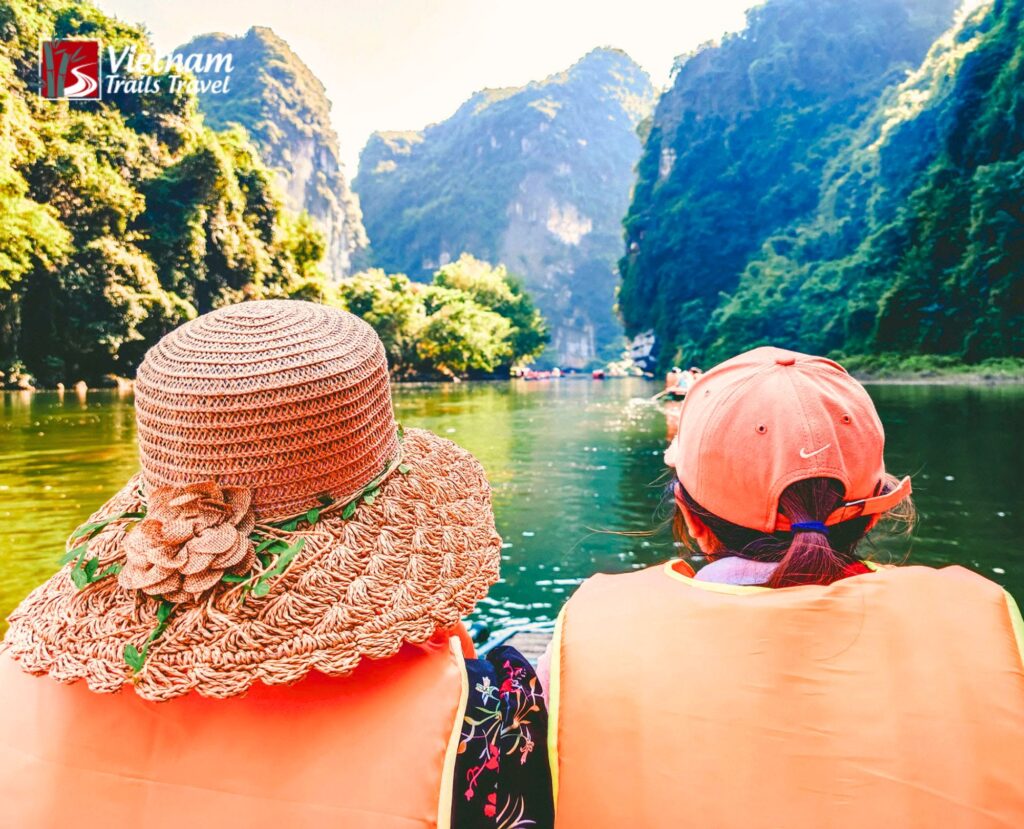
Ninh Binh sits about 95 kilometers south of Hanoi in northern Vietnam, roughly 1.5 to 2 hours away by road. This Ninh Binh travel guide covers how to reach the province, when to go, where to stay, what to eat and the top things to do in Ninh Binh.
The province is known for limestone karst scenery, boat tours through caves, and historic sites from the first capital of Vietnam. Most travelers arrive on a day trip from the capital, though two full days let you see the region at a comfortable pace. Read on for practical logistics, ticket prices, and sample itineraries you can follow.
1. Why should you visit Ninh Binh?
Ninh Binh gives travelers a mix of nature, history, and easy access. The province earned the nickname “Halong Bay on land” for its limestone peaks rising above green rice paddies and slow rivers.
In 2014, UNESCO recognized the Trang An Landscape Complex as a UNESCO World Heritage Site for both its natural and cultural value. That places it among the few mixed heritage sites in Southeast Asia, which is a strong reason to add it to any Vietnam itinerary.
The region also carries real historical weight. Hoa Lu served as the capital of Vietnam in the 10th and 11th centuries, under the Dinh and early Le dynasties. Temple ruins and old citadel walls still stand among the karst hills. Film fans may recognize the scenery too, since parts of Kong: Skull Island were shot in the area.
For most travelers, the appeal is practical. You can take a boat ride through the grottoes in the morning, cycle past the fields in the afternoon, and climb to a viewpoint at sunset, all within a compact area.
Ninh Binh works well as a short escape or as a stop on a longer trip heading south. Compared with busier destinations, the pace here is slower, and the countryside stays close at hand even near the main sites.
The province suits a wide range of visitors. Families find it manageable, since distances are short and the water is calm. Photographers come for the paddies and karst peaks. History travelers focus on Hoa Lu and the pagodas. Anyone looking for a quiet few days in the north will find this an easy destination to enjoy.
Costs here stay reasonable by regional standards. Boat tickets, temple entry, and meals are modest, and mid-range hotels are good value. A comfortable two-day visit to Ninh Binh, including transport, accommodation, tickets and food, often lands between 2,000,000 and 4,000,000 VND per person, depending on how you travel and where you stay. That value, paired with the scenery, is why the area keeps drawing repeat visitors.
Since July 1, 2025, Ninh Binh province officially merged with the former Ha Nam and Nam Dinh provinces into a larger administrative unit, still named Ninh Binh, with its center in Hoa Lu.
The change is mainly administrative and does not affect the attractions or tourist routes. Newer maps and booking platforms may show updated names and boundaries.
One useful result for visitors: the expanded province now includes Tam Chuc Pagoda, formerly in Ha Nam, alongside Bai Dinh, which gives the area two of the largest temple complexes in the country. For trip planning, the core sights around Tam Coc, Trang An, and Hoa Lu remain exactly where they were.
2. Best time to visit Ninh Binh
The ideal window falls twice a year: March to May and September to November. Temperatures during these months stay comfortable, usually around 21 to 27 degrees Celsius, and rainfall is lower. Boat tours and cycling are most pleasant in this range. These months also line up with the two rice harvests, which turn the paddies gold.
2.1. Ninh Binh weather by season
The north has four seasons, and this province follows the same pattern. Winter, from December to February, brings cool and sometimes grey weather, with temperatures dropping to 15 degrees Celsius or lower.
Fog can settle over the karst peaks, which looks striking but limits long views. Spring, from March to May, is mild and green, with steady conditions for outdoor activities.
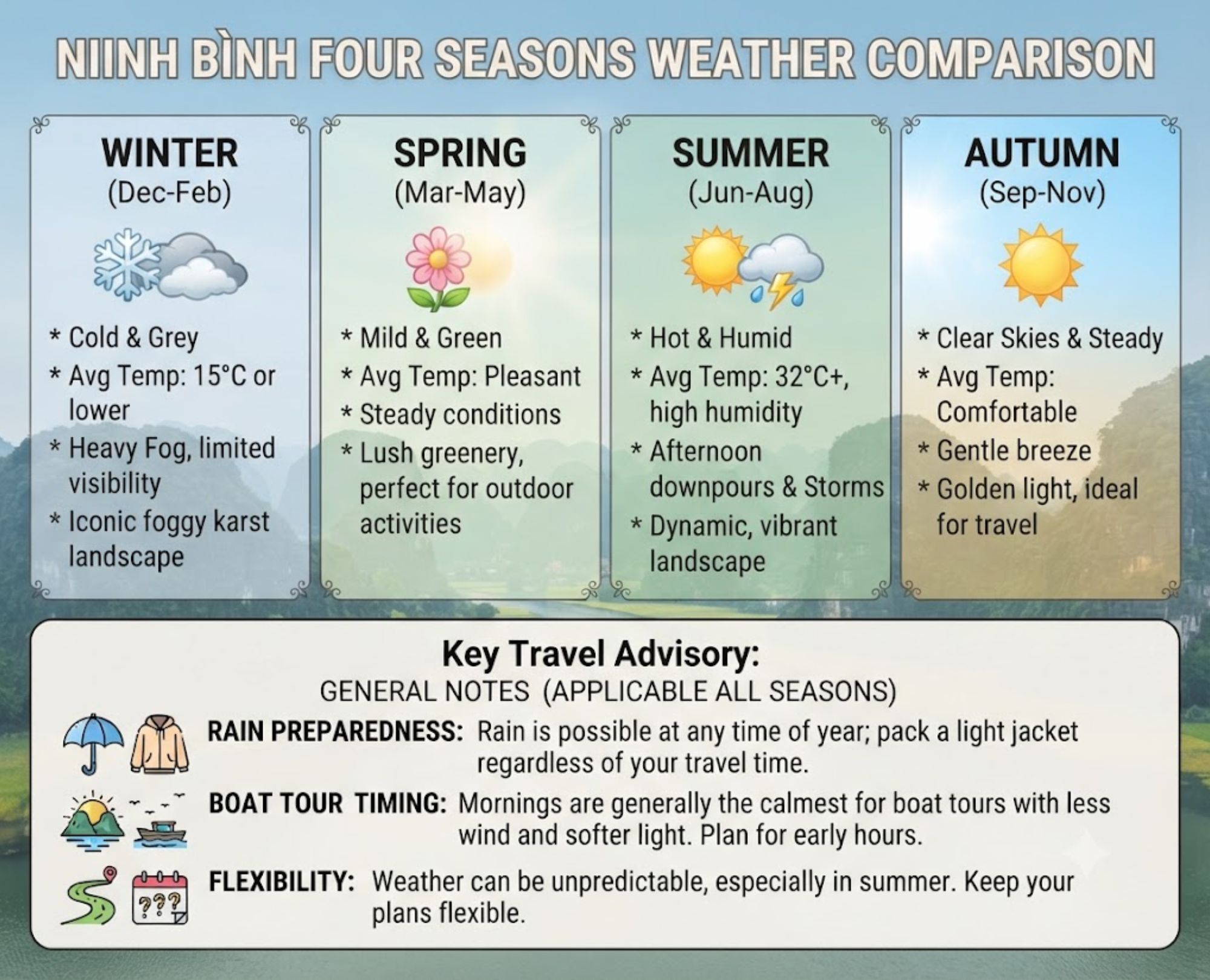
Summer, from June to August, is hot and humid. Daytime highs climb above 32 degrees Celsius, and afternoon downpours are common. Storms pass through the region during these months, so keep your plans flexible. Autumn, from September to November, returns to clearer skies and steady temperatures, which many travelers consider the sweet spot for a visit.
Rain can arrive in any season, so pack a light jacket regardless of when you travel. Mornings are usually the calmest part of the day for a boat tour, with less wind and softer light. If you can only pick one time slot for the water, aim for the early hours after the piers open.
2.2. Rice harvest and lotus season
The paddies shape the way the landscape looks through the year. The golden rice season runs from late May to mid-June, when the rice fields along the Ngo Dong River turn yellow before harvest.
This is the most popular time for photos at Tam Coc and the Mua Cave viewpoint, and boats fill up quickly. A second harvest colors the rice fields again around late September and October, with slightly smaller crowds.
Lotus season overlaps with early summer, roughly May to July, when ponds near Hang Mua fill with pink blooms. Between harvests, the fields turn a fresh green, which photographs well in a different way.
If your trip lines up with either the golden rice or the lotus, plan an early start to beat both the heat and the crowds. Weekdays are quieter than weekends across every season.
3. How to get to Ninh Binh from Hanoi
The province sits around 95 kilometers south of the capital, and the journey takes roughly 1.5 to 2.5 hours depending on the transport you choose. There is no airport in Ninh Binh, so all routes run through Hanoi.
The main options for the Hanoi to Ninh Binh route are private car, limousine van, train, and bus. Here is how each one works, with approximate prices and travel times.
3.1. By private car with driver
A private car with driver is the fastest and most flexible way to reach the region. The drive takes about 1.5 hours door to door, since the car collects you at your hotel in the Old Quarter and drops you at your accommodation in Tam Coc or Trang An. You skip the transfers to and from stations, which saves real time on both ends.
Prices usually range from 1,200,000 to 1,600,000 VND per car one way, depending on vehicle size. A four-seat sedan suits couples and solo travelers. A seven-seat SUV or 16-seat van works for families and groups with luggage.
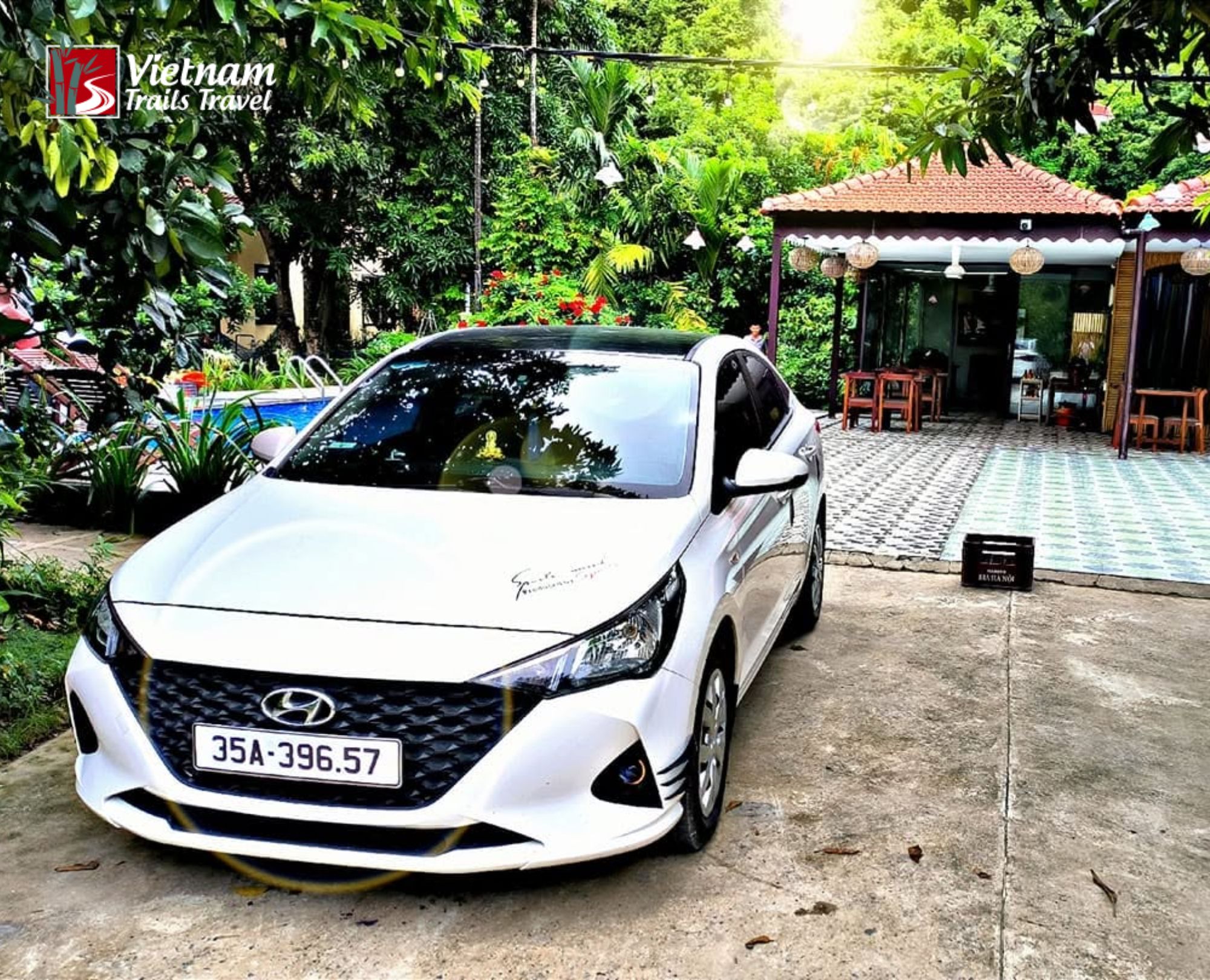
This option also lets you set your own schedule, stop for photos, and combine several sights on the way. Vietnam Trails Travels arranges private cars with English-speaking drivers and fixed pickup times, which removes the guesswork for first-time visitors and keeps the day on track.
3.2. By limousine van
Limousine vans are the most common choice among independent travelers. In Vietnam, “limousine” means a converted minibus with wide reclining seats, usually 9 to 16 places. The ride takes about 2 hours. Many operators offer door-to-door service, collecting you in the center of the capital and dropping you in Tam Coc for a small extra fee.
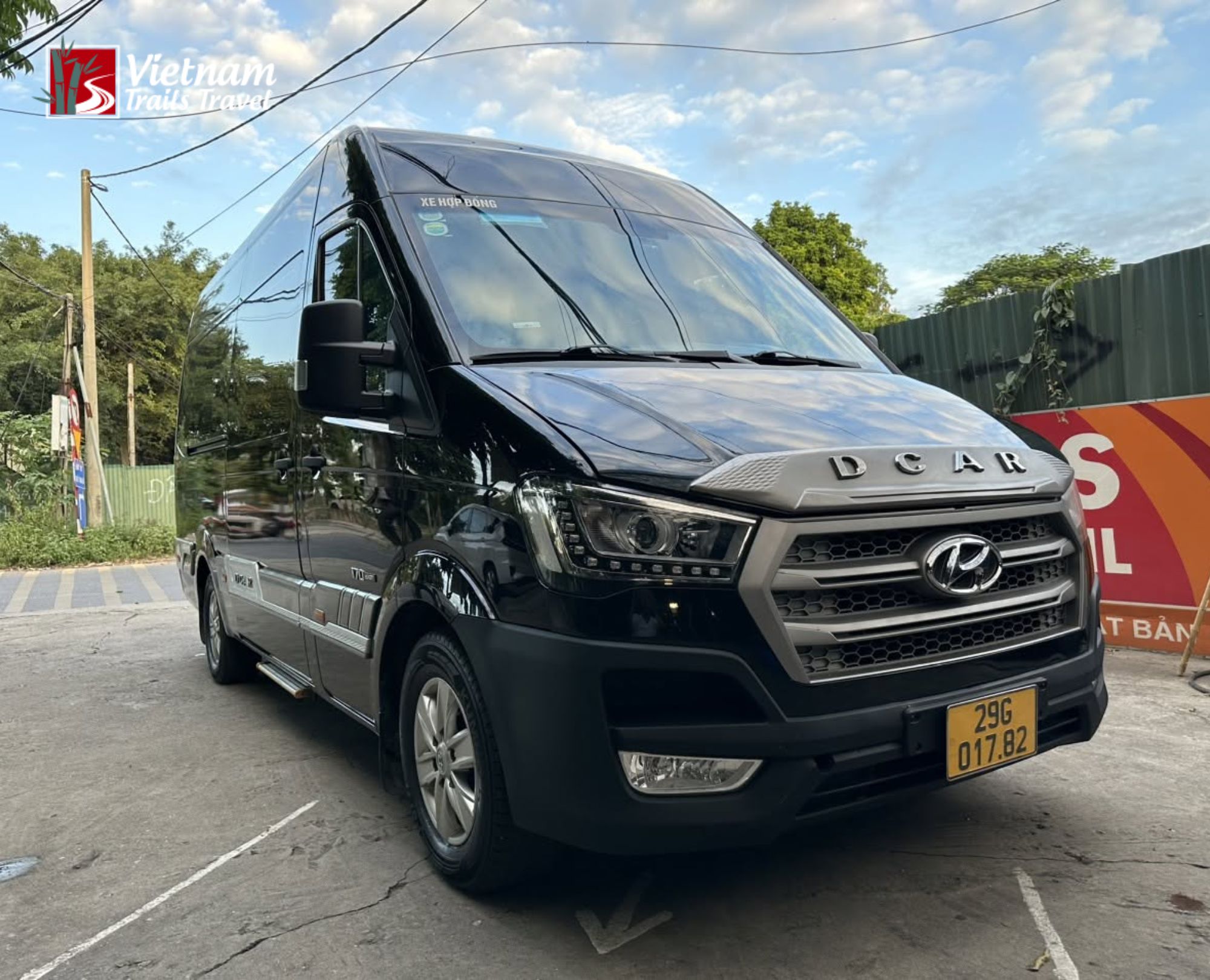
Tickets cost around 150,000 to 300,000 VND per person. Vans run throughout the day, so departures are frequent. Booking a day ahead is wise on weekends and during Vietnamese holidays, when seats sell out. This option balances comfort and cost, which is why it suits most travelers who do not need a full private car.
3.3. By train
Trains link the two cities in about 2 to 2.5 hours. Ninh Binh station sits in the town center, which keeps onward taxi rides short. Tickets range from roughly 90,000 to 250,000 VND depending on the seat or berth class. The train gives a steady, comfortable ride, and the scenery along the way is pleasant.

This route works well if you also plan to continue south toward Hue, Da Nang, or Phong Nha later, since the same north-to-south line runs through the province. You can board here and skip a night’s accommodation on a sleeper service. Buy tickets in advance through Vietnam Railways or a booking platform, especially around holidays.
3.4. By bus
Buses are the cheapest way in. Regular services leave from Giap Bat and Nuoc Ngam stations in the capital. The trip takes about 2.5 to 3 hours, and tickets cost roughly 100,000 to 150,000 VND. Standard buses drop passengers at the local bus station rather than at hotels, so you will need a taxi or Grab for the final leg to Tam Coc or Trang An.
This choice saves money but costs time and adds transfers. It suits budget travelers who do not mind the extra steps. For a smoother arrival, the limousine van or a private car usually justifies the difference in price.
3.5. Getting around Ninh Binh
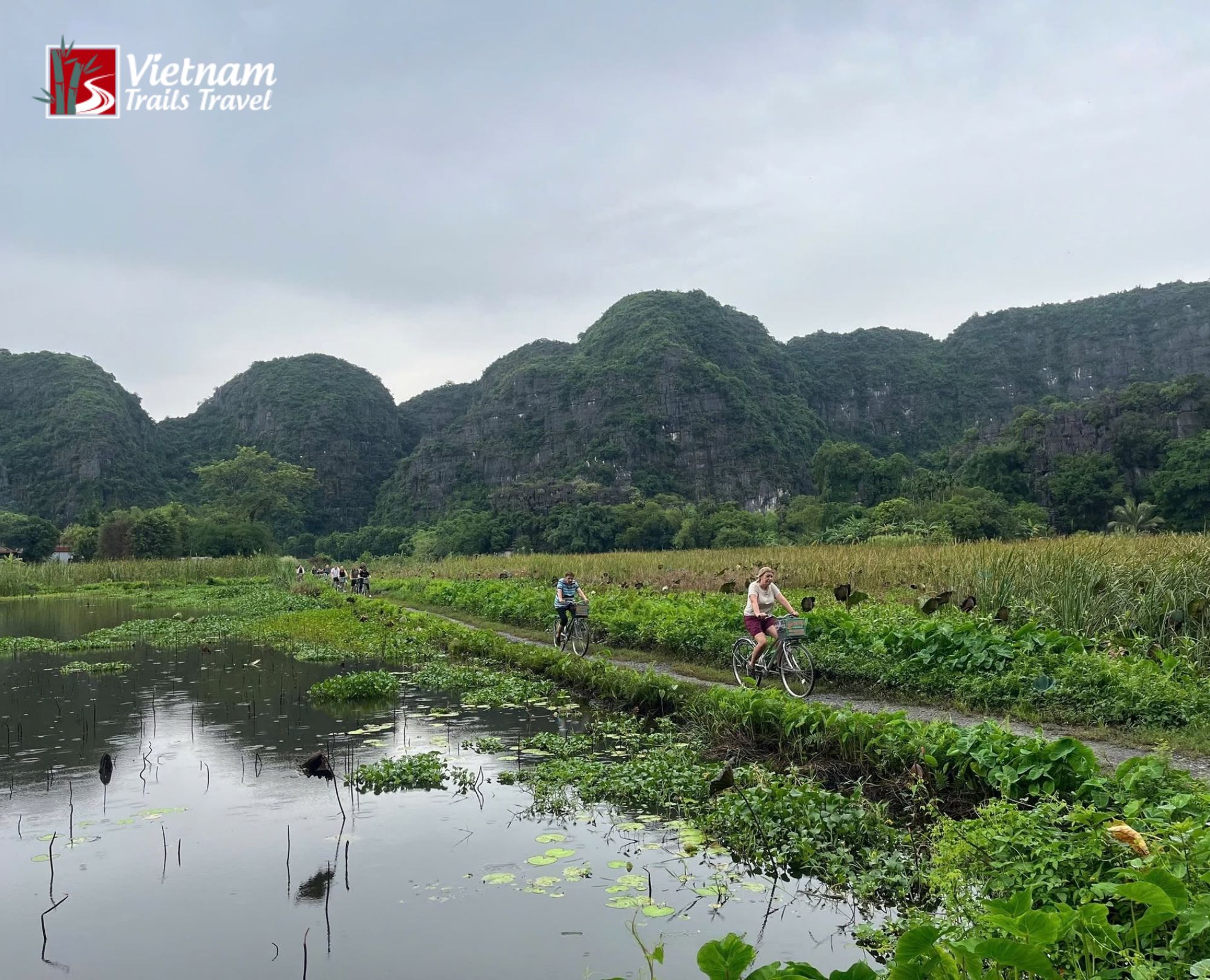
The attractions spread across Ninh Binh, so you will need transport once you arrive. Bicycles are the easiest way to explore the Tam Coc scenic area, and many homestays lend them for free or a small fee. The lanes through the paddies are flat and quiet, and you can cycle between Tam Coc and nearby sites in under 30 minutes.
For longer distances, Grab and local taxis are reliable. A short ride within the area usually costs 50,000 to 200,000 VND. Motorbike rental runs about 100,000 to 150,000 VND per day for confident riders, though the roads near the main sites can get busy.
Travelers who prefer comfort often hire a private car with a driver by the day. This covers all the main sights on a set route without the hassle of parking, fuel, or navigation, and it works well for families and older visitors. A full day with a driver typically costs 1,000,000 to 1,800,000 VND, split across your group.
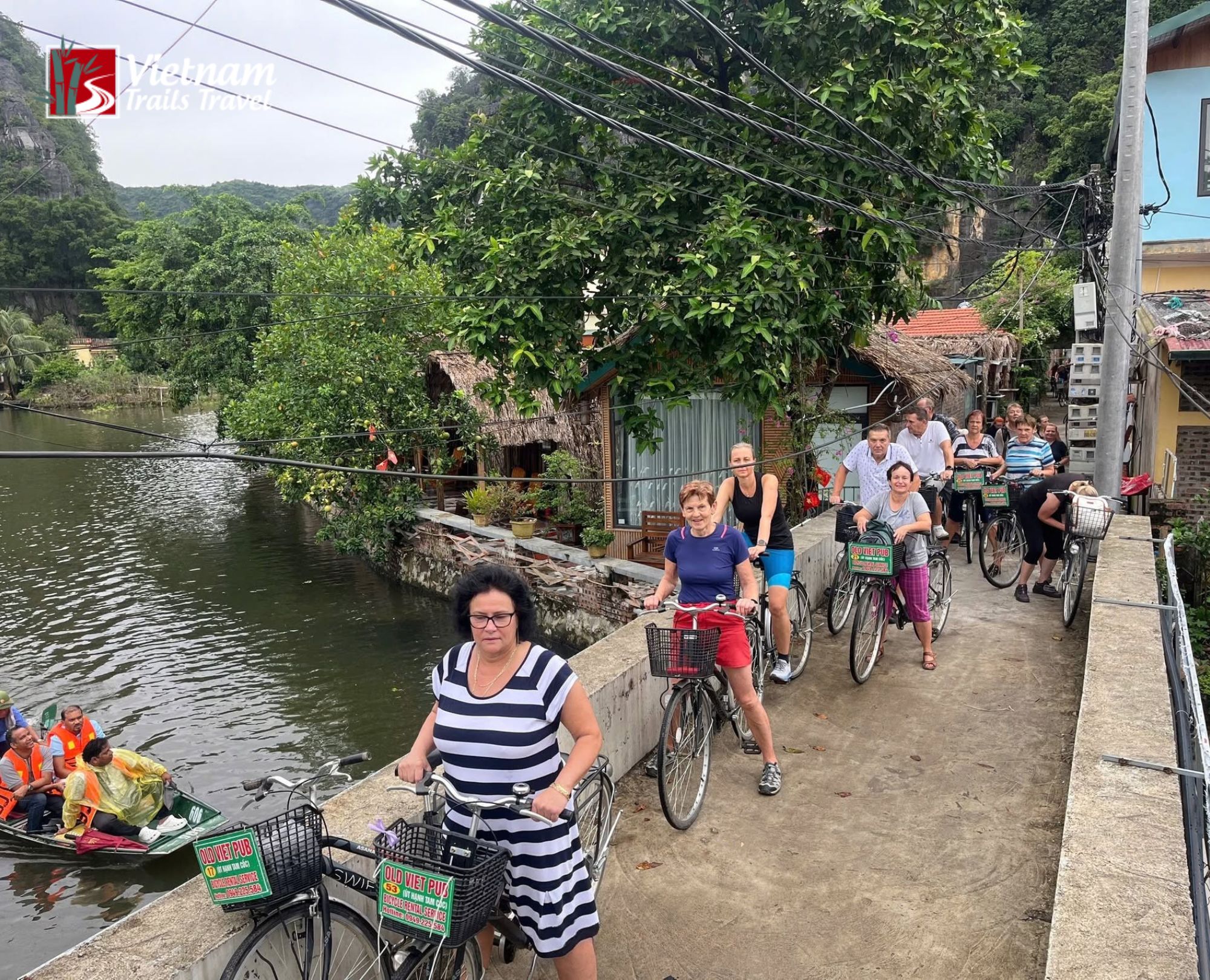
Cycling is the most enjoyable way to see the countryside up close. A loop from Tam Coc out to the fields and back takes one to two hours at an easy pace, and the terrain stays flat.
Traffic on the small lanes is light, though the main road toward the sites carries buses and trucks, so ride with care. Helmets come with most motorbike rentals, and you should wear one at all times. For anyone not used to local roads, a car with a driver removes the stress and lets you watch the scenery instead of the traffic.
4. Top things to do in Ninh Binh
The best things to do in Ninh Binh center on boat tours, caves, temples, and viewpoints. Below are the seven sites most worth your time, with addresses, opening hours, and ticket prices. Most travelers combine three or four of these in a single day, since the distances between them are short.
4.1. Trang An boat tour
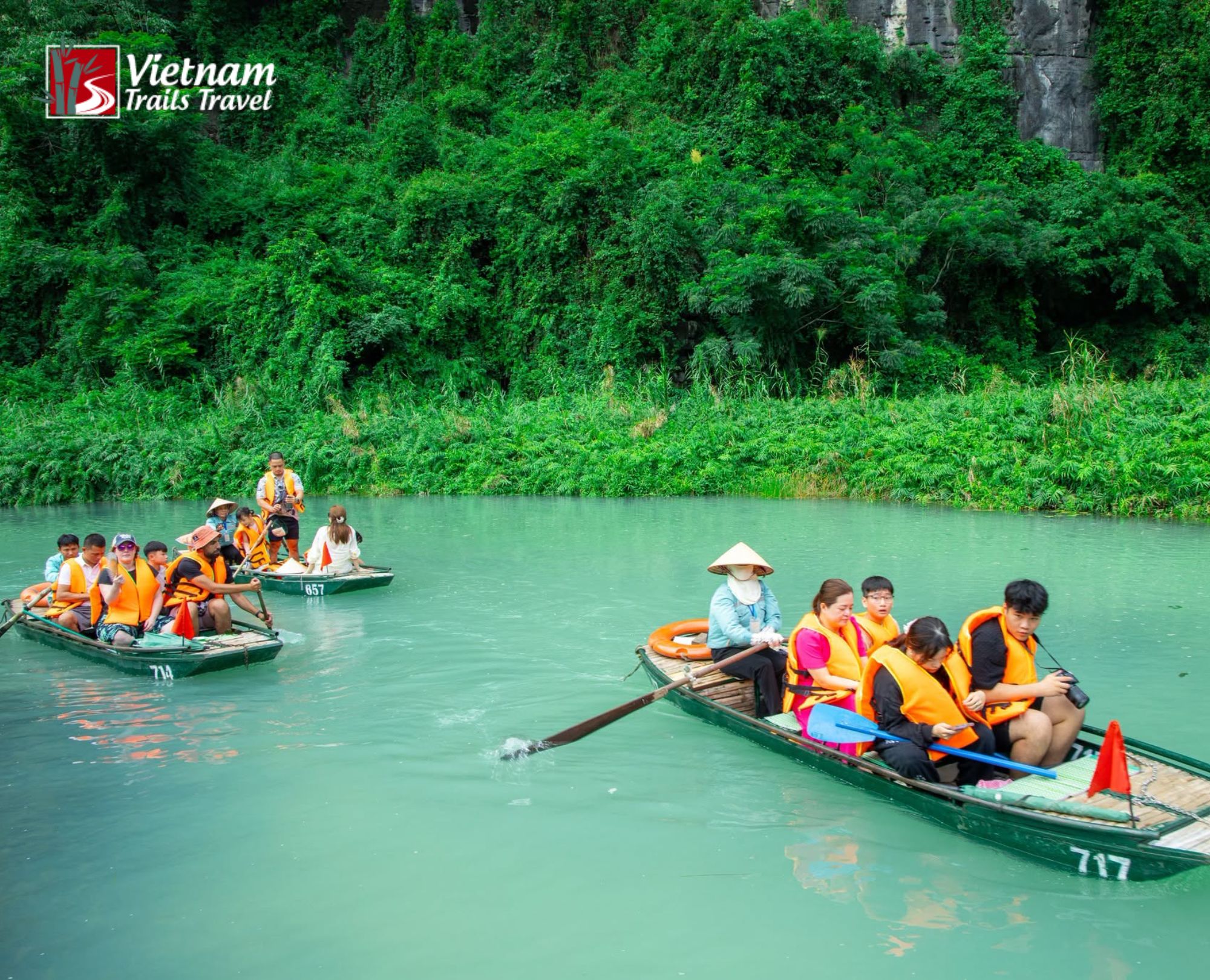
The Trang An boat tour is the signature experience in the province. Wooden rowing boats carry up to four passengers through a network of rivers, caves, and temples inside the UNESCO-listed Trang An Landscape Complex.
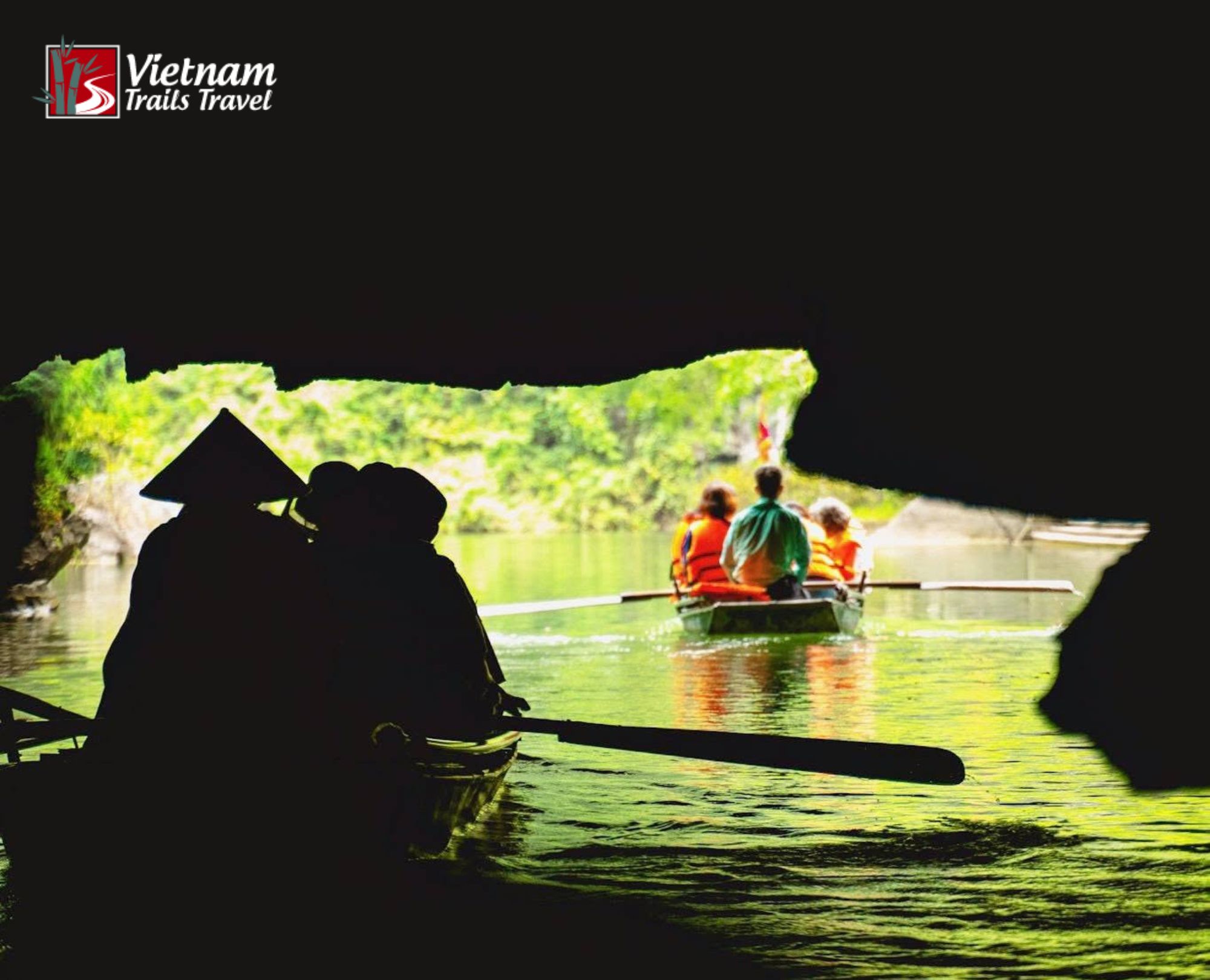
The full route lasts about 2.5 to 3 hours and passes through several low caves, with stops at small pagodas and film set locations along the way. Ducking through the darker caves is part of the appeal, and the water stays calm throughout. Some tunnels sit low enough that you lower your head as the boat glides beneath the rock.
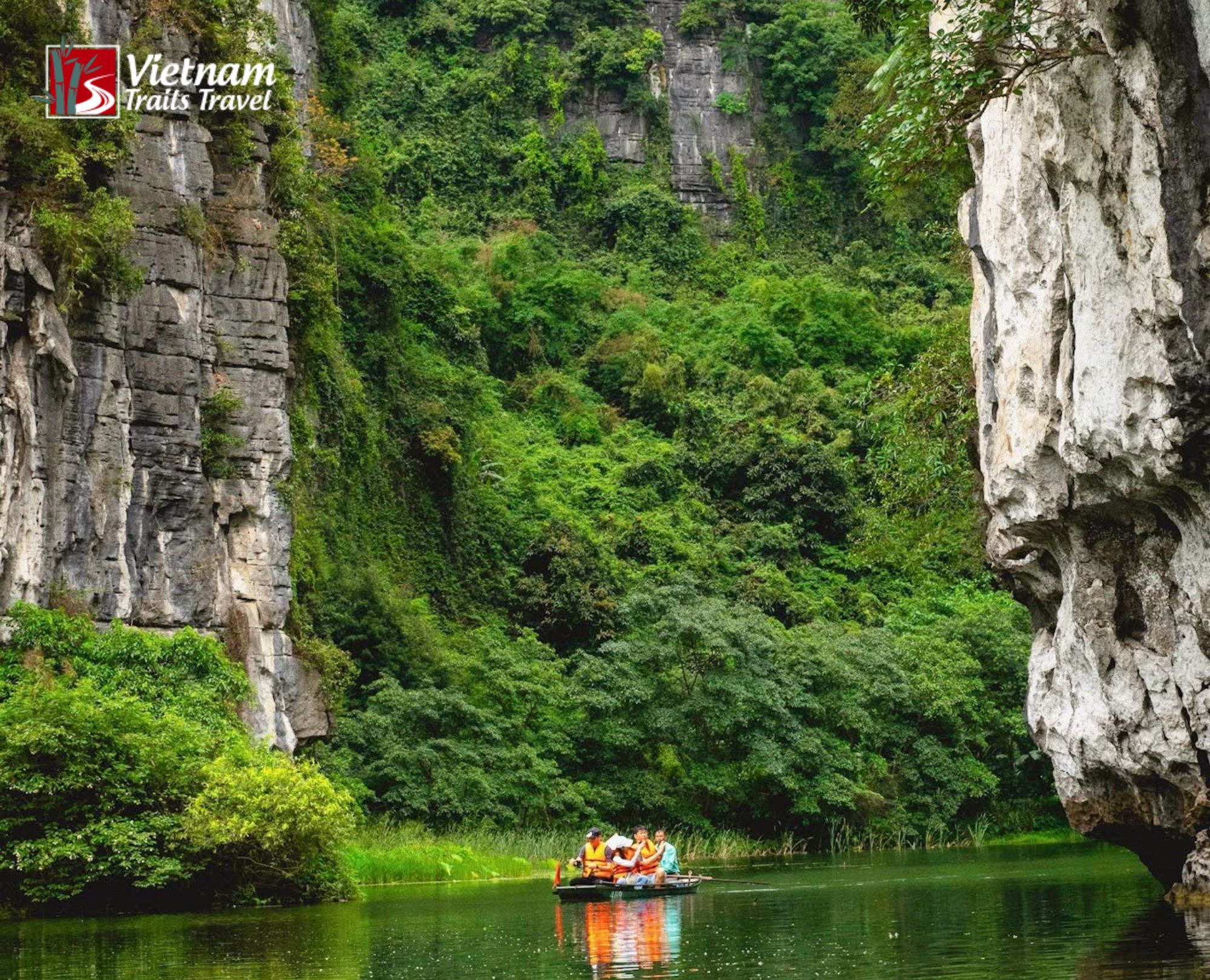
Tickets cost around 300,000 VND per adult, and boats are rowed by hand. There are three main routes, each with a different mix of grottoes and temple stops. The complex sits about 7 kilometers from the town center and the pier opens from 07:00 to 16:00. Early morning gives the best light and the fewest people, before the group tours arrive.
Address: Tràng An, Hoa Lư, Ninh Bình.
4.2. Tam Coc boat tour
The Tam Coc boat tour follows the Ngo Dong River past three natural grottoes: Hang Ca, Hang Hai, and Hang Ba. The scenery here is more open than at Trang An, with rice fields running right up to the water.
The three grottoes are shallow and cool, and you drift through them in turn. The round trip lasts about 1.5 to 2 hours, which makes it shorter and cheaper than the Trang An boat tour.
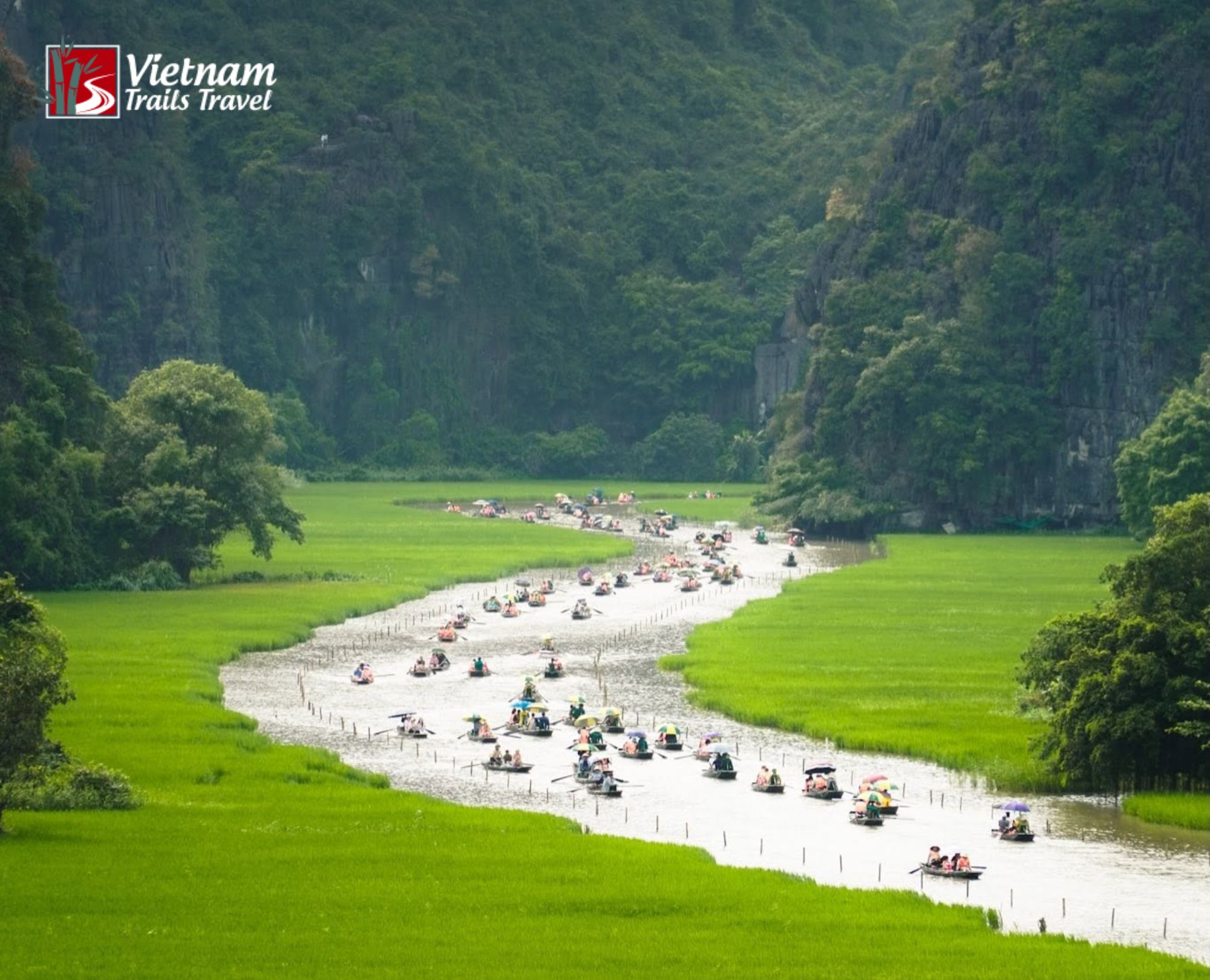
Tickets cost around 300,000 VND per adult plus a boat fee. Boats leave from Van Lam Pier in Tam Coc, open from 07:00 to 17:00. Local rowers here are known for steering with their feet, a technique unique to the area.
The golden season in late May and June is the most scenic time for this trip, when the paddies along the river turn yellow.
Address: Bến thuyền Tam Cốc, Ninh Hải, Hoa Lư, Ninh Bình.
4.3. Mua Cave viewpoint (Hang Mua)
Mua Cave, also called Hang Mua, delivers the most famous view in the region. A climb of about 500 steps leads to two peaks above the valley, where you can see the Ngo Dong River winding through the paddies far below. The cave itself sits at the base and holds a small shrine. A dragon statue crowns one ridge, a common spot for photos.

The entrance fee is around 150,000 VND, and the site opens from 06:00 to 19:00. The climb takes 20 to 30 minutes at a steady pace, and the stone steps can be slippery after rain, so wear proper shoes.
Sunrise and late afternoon give the coolest temperatures and the softest light. The site sits a few kilometers from Tam Coc, an easy cycle or Grab ride away.
Address: Khê Đầu Hạ, Ninh Xuân, Hoa Lư, Ninh Bình.
4.4. Hoa Lu Ancient Capital
Hoa Lu was Vietnam’s capital in the 10th and 11th centuries, under the Dinh and early Le dynasties. The grounds today hold two main temples, dedicated to Emperor Dinh Tien Hoang and Emperor Le Dai Hanh, set among karst hills that once served as natural defenses. Old walls and courtyards give a sense of the former citadel, and the carvings inside the temples reward a slow look.
Entry is free to the main temples, though a small parking fee applies. The grounds open from 07:00 to 17:00 and sit about 12 kilometers from Tam Coc. Allow about an hour to walk them.
The place pairs naturally with a Trang An boat trip, since the two are close together and often combined on the same day tour.
Address: Trường Yên, Hoa Lư, Ninh Bình.
4.5. Bai Dinh Pagoda
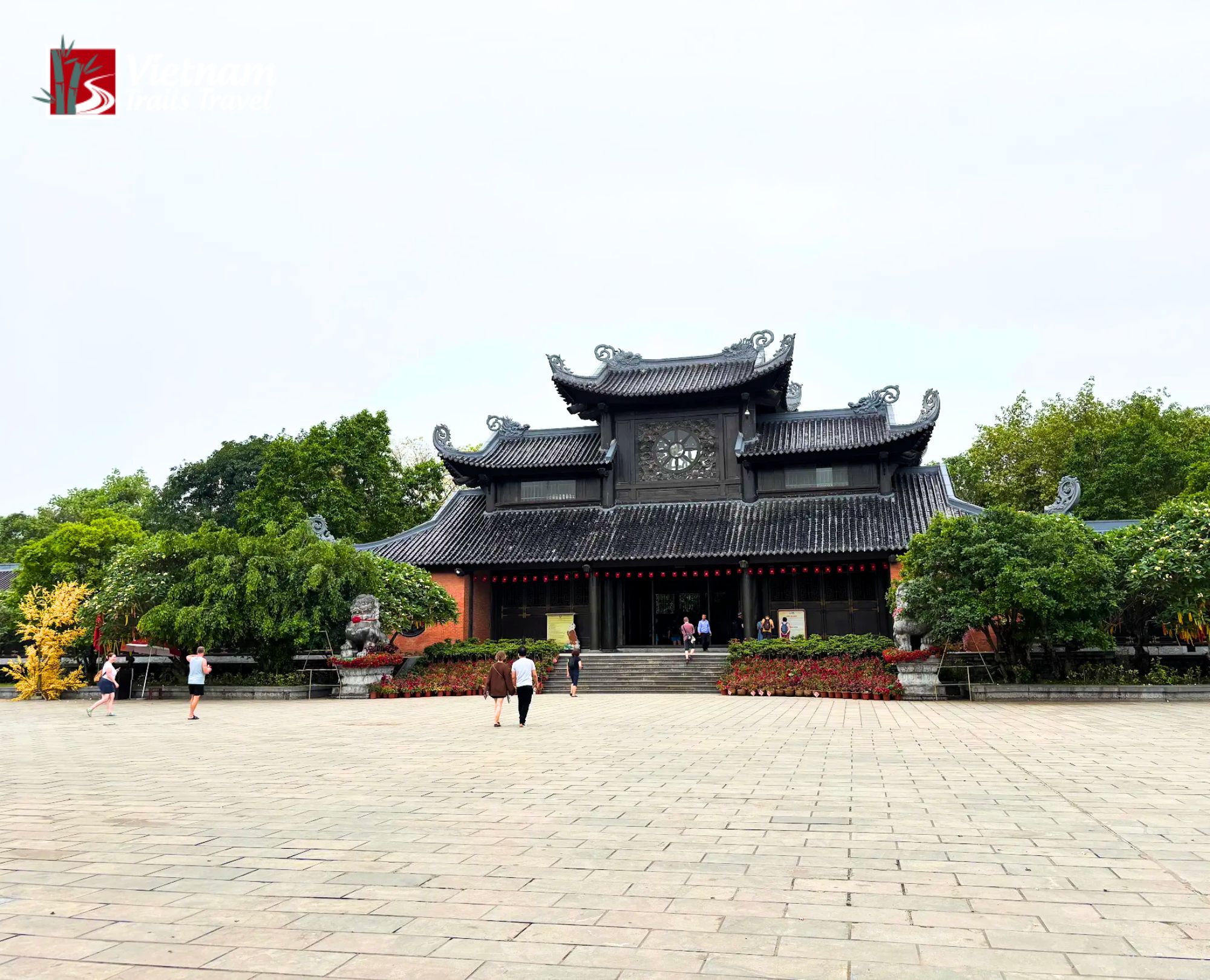
Bai Dinh is the largest Buddhist temple complex in Vietnam. The new section, completed in 2010, covers a vast area and holds a towering bronze Buddha and nearly 500 stone Arhat statues lining its corridors. An older temple sits in a cave above, reached by a climb of a few hundred steps, which is where the site’s history runs deepest.
The complex is free to enter, but electric buggies shuttle visitors across the large grounds for around 60,000 VND round trip, which most people find worthwhile given the distances.
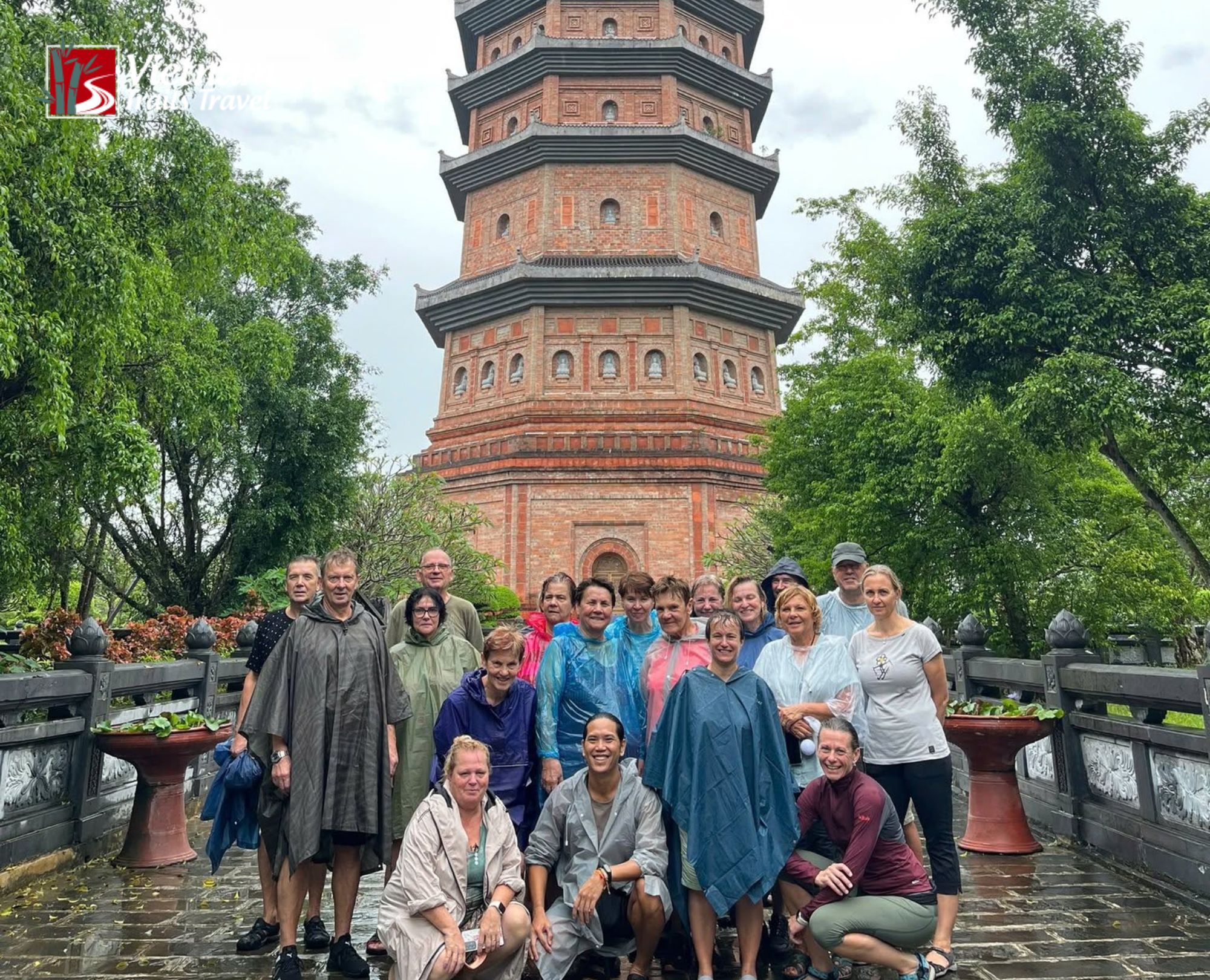
Bai Dinh opens from 06:00 to 21:00 and lies about 15 kilometers from Tam Coc. The scale is impressive, though the site feels more modern and commercial than the older temples nearby. It suits travelers interested in Buddhist architecture and large ceremonial spaces.
4.6. Van Long Nature Reserve
Van Long Nature Reserve offers a quieter boat ride than the two main tours. This wetland is home to many bird species and the rare Delacour’s langur, one of the world’s most endangered primates.
The still water reflects the karst peaks, which makes it a favorite among landscape photographers, especially at dawn and in autumn when the reeds bloom.
A boat ride here costs around 60,000 to 100,000 VND and lasts about an hour. Van Long lies roughly 25 kilometers north of Tam Coc, so reaching it takes some planning. The reserve rewards travelers who want calm scenery and wildlife over busier tourist spots.
Address: Gia Vân, Gia Viễn, Ninh Bình.
4.7. Cuc Phuong National Park
Cuc Phuong is the oldest national park in Vietnam, covering around 22,000 hectares of forest. The park holds hiking trails, ancient trees and the Endangered Primate Rescue Center, where you can learn about langurs and gibbons. A thousand-year-old tree and the Cave of Prehistoric Man sit deeper in the forest, reached on longer guided treks.
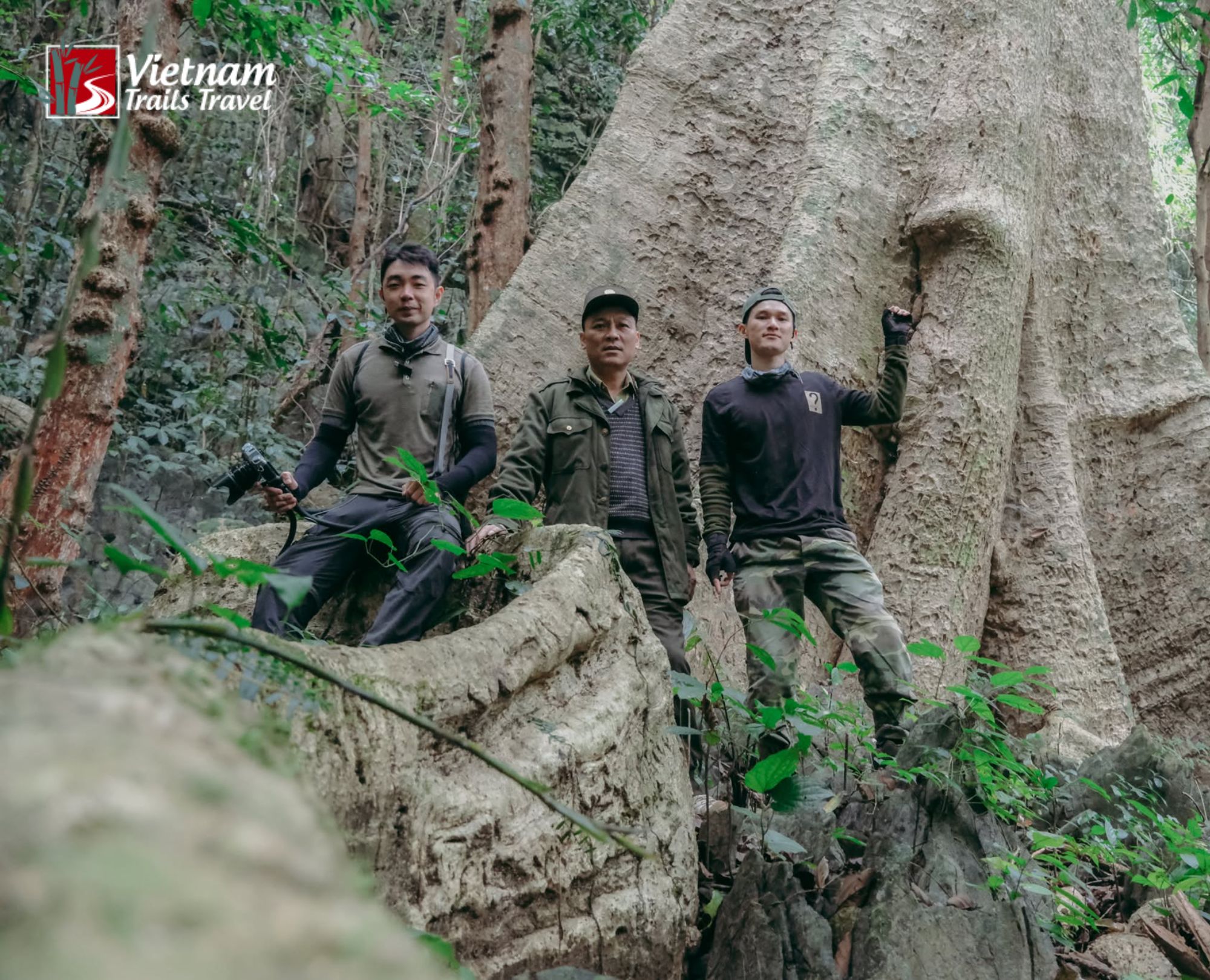
Entry costs about 60,000 VND. The park lies around 45 kilometers from Tam Coc, roughly an hour by car, so it usually needs a full day or an overnight stay inside the grounds.
Butterfly season, from April to June, fills the trails with color and draws many visitors. This park suits nature lovers and families with an interest in conservation.
Address: Cúc Phương, Nho Quan, Ninh Bình.
4.8. Bich Dong Pagoda
Bich Dong Pagoda deserves a stop for anyone based in Tam Coc, since it sits only a few kilometers away and makes an easy add-on to a boat tour. The pagoda is built into the side of a limestone cliff across three levels, linked by stone stairs, with a small cave temple in the middle. A stone bridge over a lotus pond leads to the entrance.
Entry is free, and it opens through daylight hours. The climb between levels is short, and the upper terrace gives a quiet view over the surrounding fields. Many travelers cycle here from Tam Coc in about 15 minutes, which pairs well with a morning on the water.
Address: Ninh Hải, Hoa Lư, Ninh Bình.
5. Trang An vs Tam Coc: which boat tour to choose?
Trang An and Tam Coc are the two main boat tours in Ninh Binh, and many travelers wonder which one to pick. If you have time for only one, here is how they compare.
Trang An is longer, at about 2.5 to 3 hours, and winds through more grottoes and past several temples. The route feels more varied, and the water is calmer. It costs around 300,000 VND. Tam Coc runs about 1.5 to 2 hours along the Ngo Dong River, with open rice field views and three grottoes. It is shorter and cheaper, at around 150,000 VND.
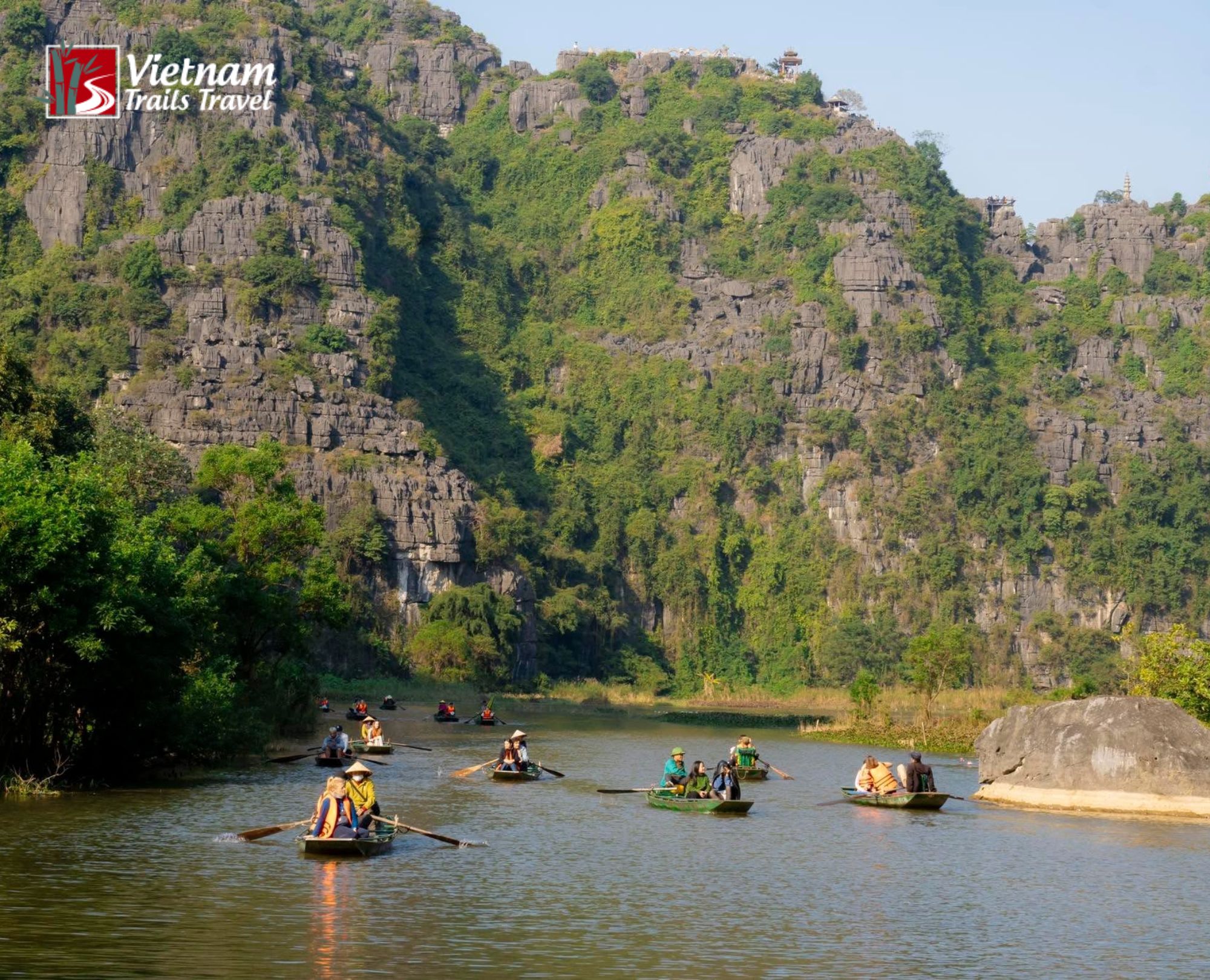
For scenery and caves, Trang An is the stronger choice, and the temple stops break up the ride. For paddies and a quicker trip, Tam Coc fits better, and the golden season makes it memorable.
If your schedule allows, doing both on separate mornings gives you the full picture of the waterways. Most guided tours include one or the other, so check the itinerary before you book. When a tour offers a choice, the longer Trang An route tends to satisfy first-time visitors more.
6. Where to stay in Ninh Binh?
Where to stay in Ninh Binh depends on the kind of trip you want. The three main areas are Tam Coc, Trang An, and the city center. Each has a different feel, price range, and level of convenience.
Prices span a wide range. Budget dorms and homestays start around 150,000 to 300,000 VND a night, mid-range hotels with a pool sit near 600,000 to 1,200,000 VND and the higher-end eco resorts run above that. Booking two to three weeks ahead is wise in the golden season and on weekends, when the best rooms near the water fill first.
6.1. Tam Coc area
Tam Coc is the traveler hub of Ninh Binh. The streets around the pier hold cafes, restaurants, guesthouses, and bike rentals within walking distance. This area works well for first-time visitors who want everything close and a social atmosphere in the evening. Rooms range from budget dorms to mid-range boutique hotels with a pool and river views.
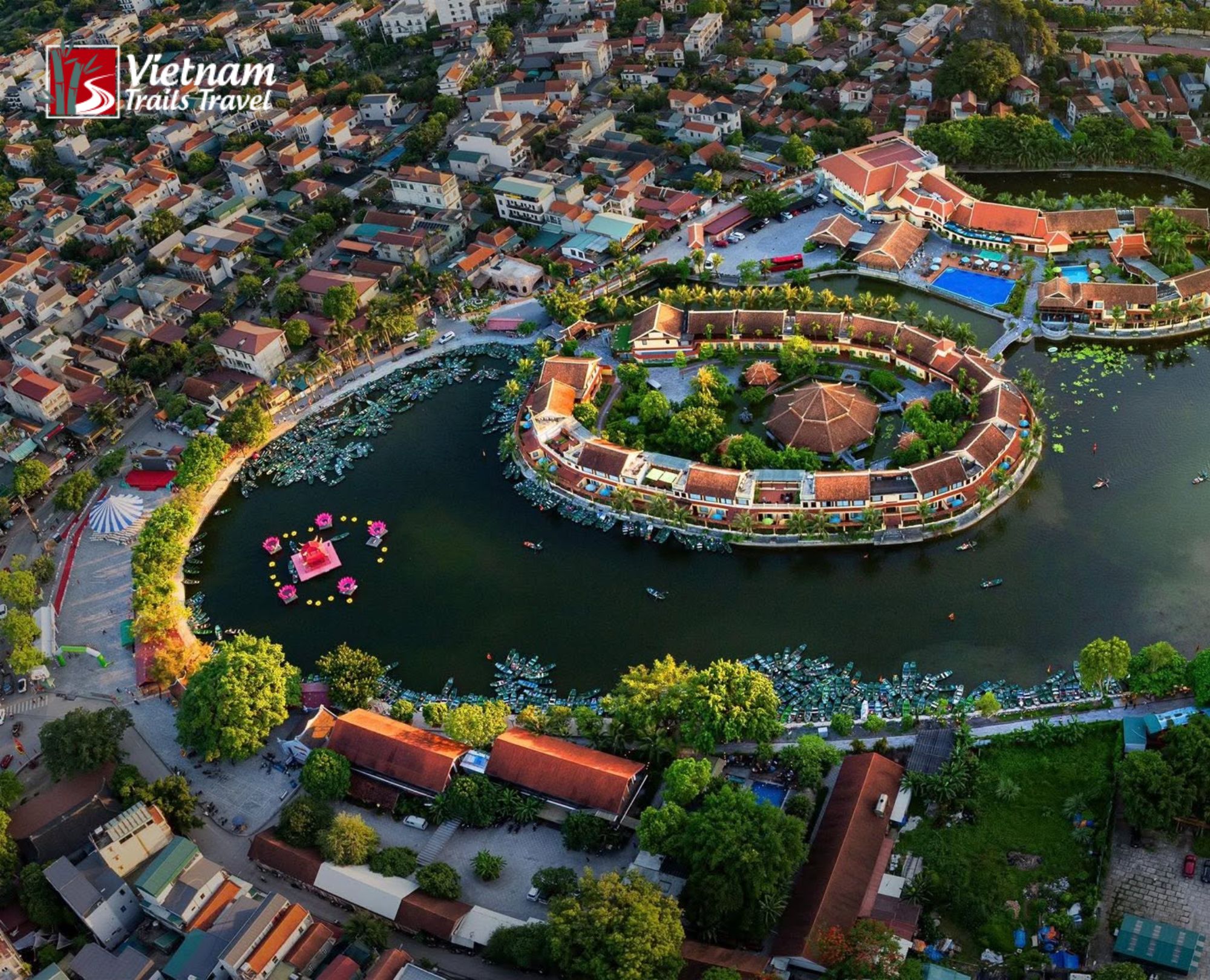
A base in Tam Coc keeps you near the boat tour, the famous viewpoint, and Bich Dong Pagoda, all reachable by bicycle. The trade-off is that the main street can get busy at peak hours, when day tour buses arrive. For most travelers, the convenience outweighs the crowds.
6.2. Trang An area
Trang An sits about 20 minutes north of Tam Coc and spreads out among the karst peaks. Accommodation here leans toward eco lodges, homestays, and quiet resorts set in the countryside. This area suits travelers who prefer nature and calm over walkable streets and nightlife. The views from the rooms are often the highlight of a stay.
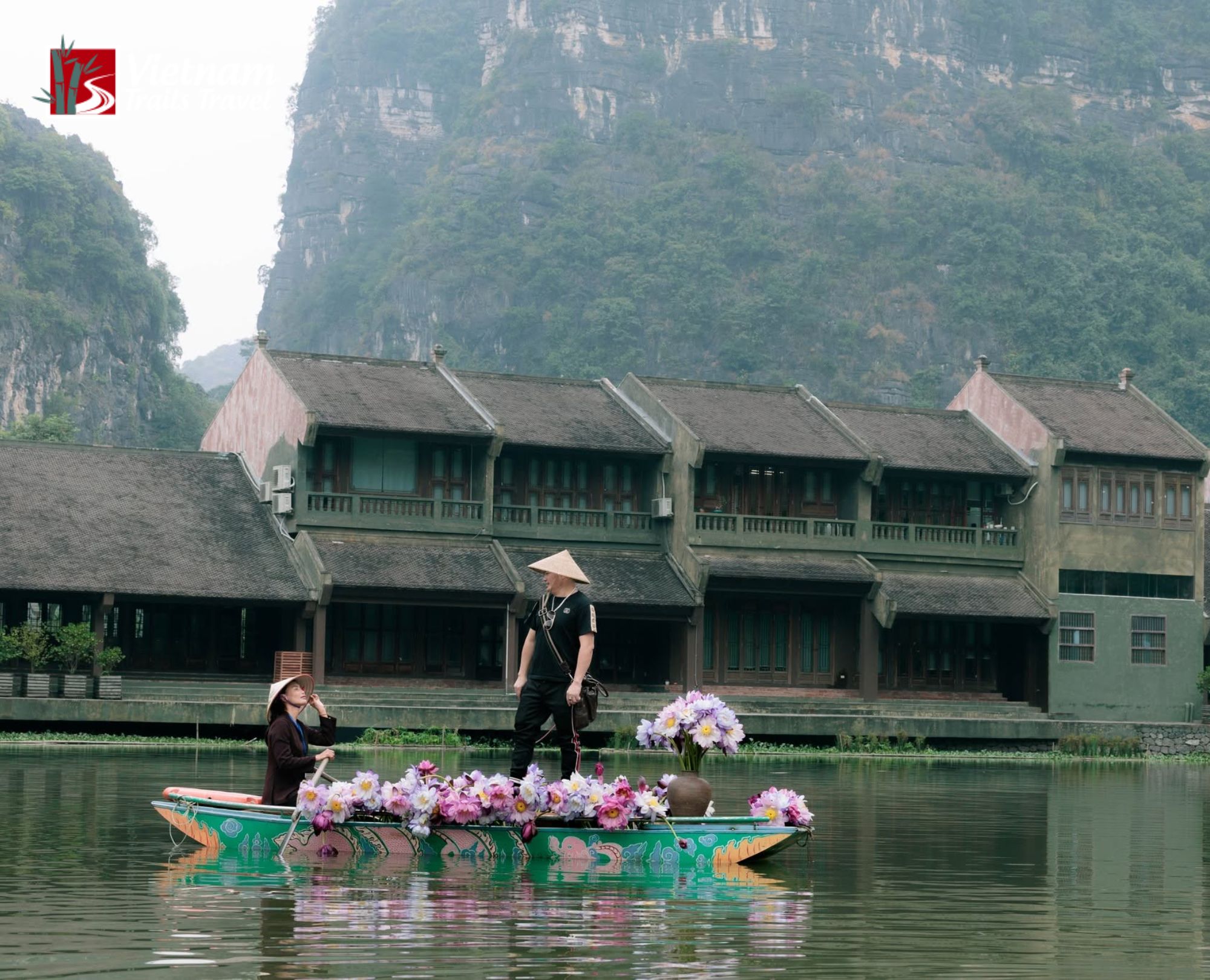
You will rely more on a bike, Grab, or private car to get around from a Trang An base, since restaurants and shops are more spread out. For couples and anyone after a restful few days, the setting is worth the extra effort of moving around.
6.3. Ninh Binh city
The city center offers urban amenities, a wider choice of hotels, and better transport links, including the train station. The center has more restaurants, shops, and ATMs, though it lacks the scenery of Tam Coc and Trang An. It works as a base if you arrive late by train or plan to explore widely across the province by car.
7. What to eat in Ninh Binh
Ninh Binh has a distinct local cuisine built around goat, rice, and the karst landscape itself. Below are the dishes locals rate highest, with Vietnamese names included so you can order with confidence.
7.1. Thịt dê núi (mountain goat)
Goat is the signature protein of the province. The animals graze on limestone hills, which gives the meat a firm, lean texture that lowland goat lacks. Restaurants serve it grilled with sesame, steamed with herbs, or in hotpot.
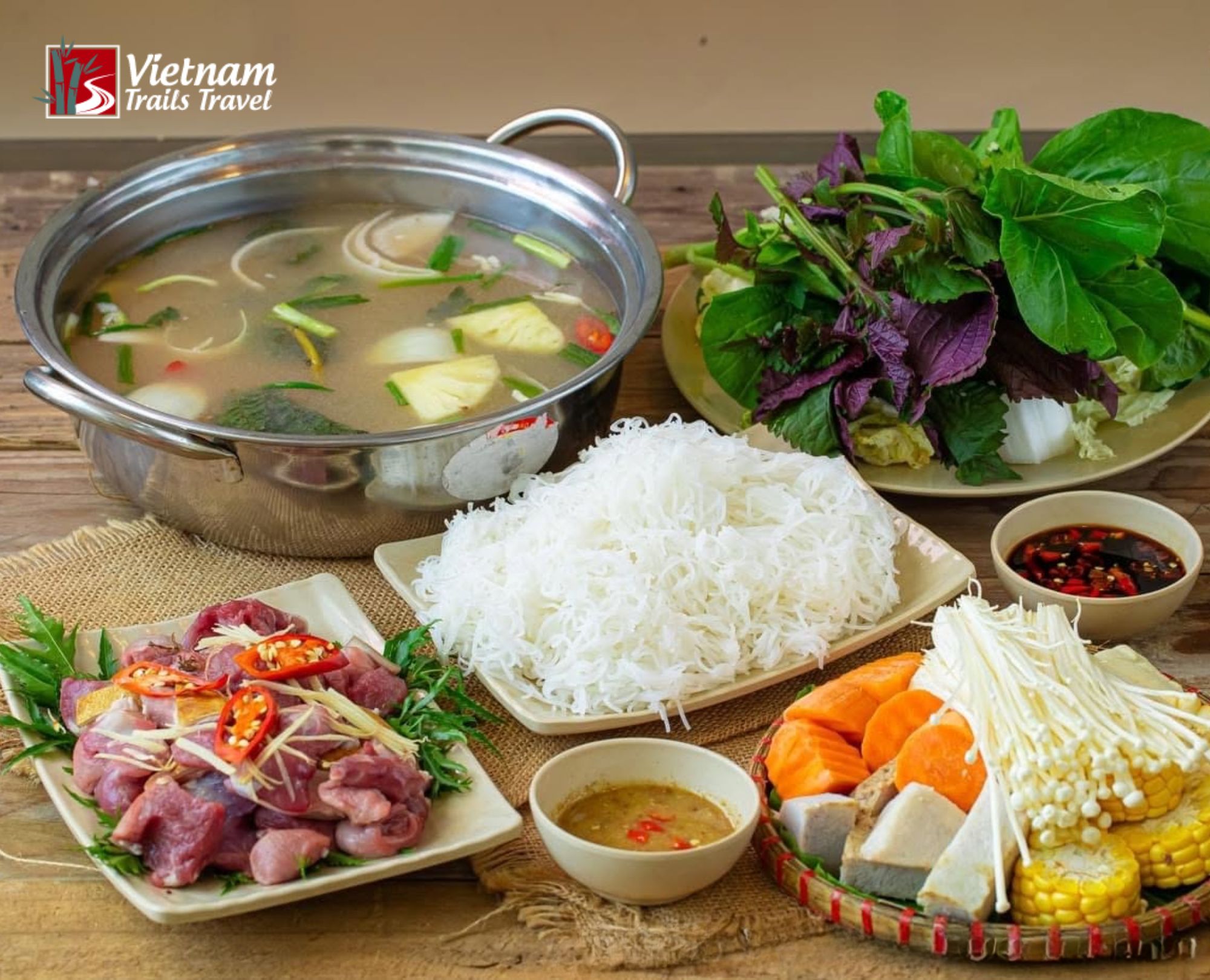
First timers should order tái dê, thinly sliced goat served with green banana, star fruit, fresh herbs, and rice paper for wrapping. The best goat restaurants cluster near Tam Coc and Gia Vien, where the dish is a point of local pride.
7.2. Cơm cháy (crispy rice)
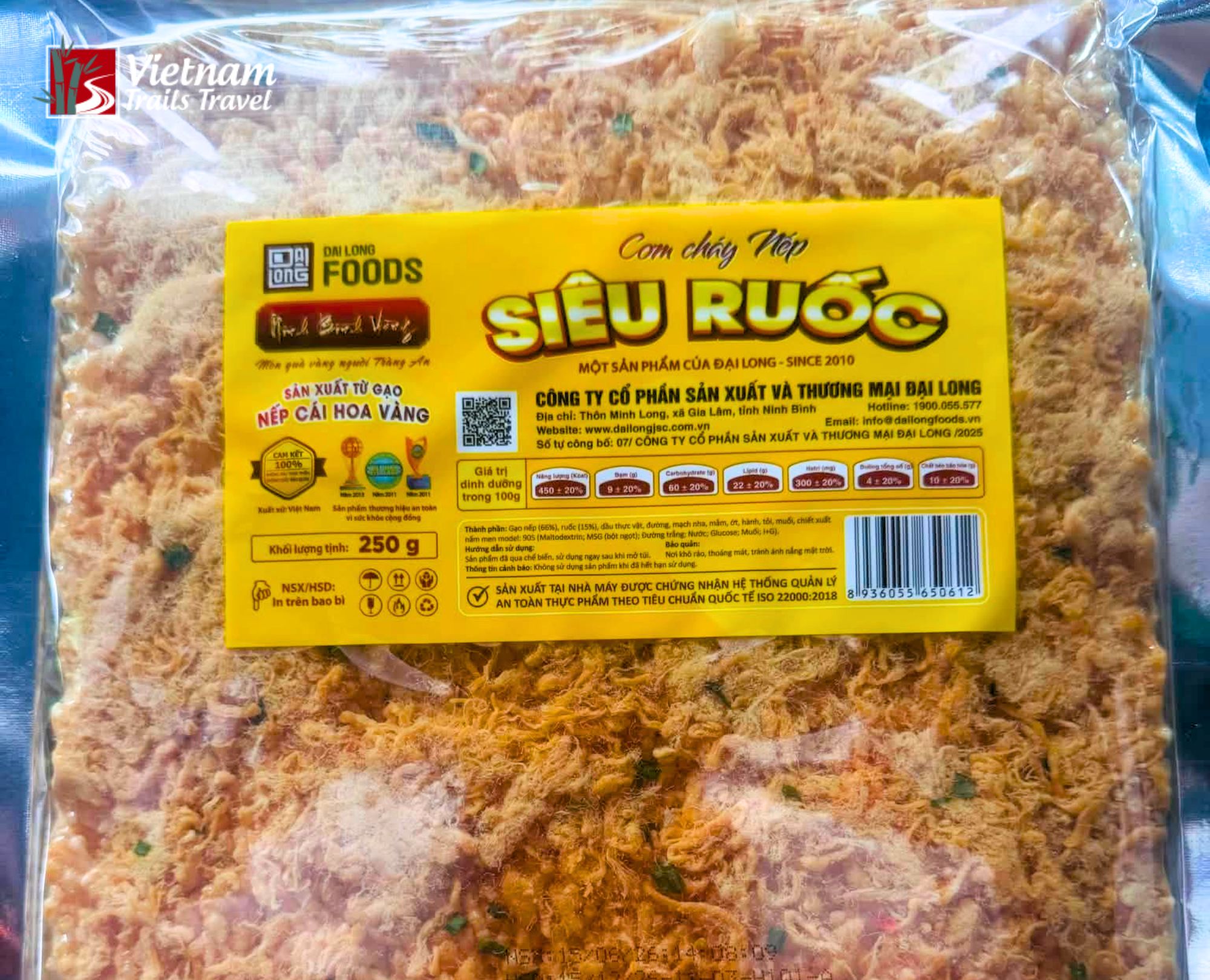
Cooks press cooked rice into a flat cake, dry it, then fry it until golden and crunchy. A savory sauce of meat, vegetables, and sometimes goat drippings goes on top. The dish keeps well, so shops sell boxed versions that travel home as souvenirs. A plate of cơm cháy beside a goat platter is the classic local order.
7.3. Miến lươn (eel vermicelli)
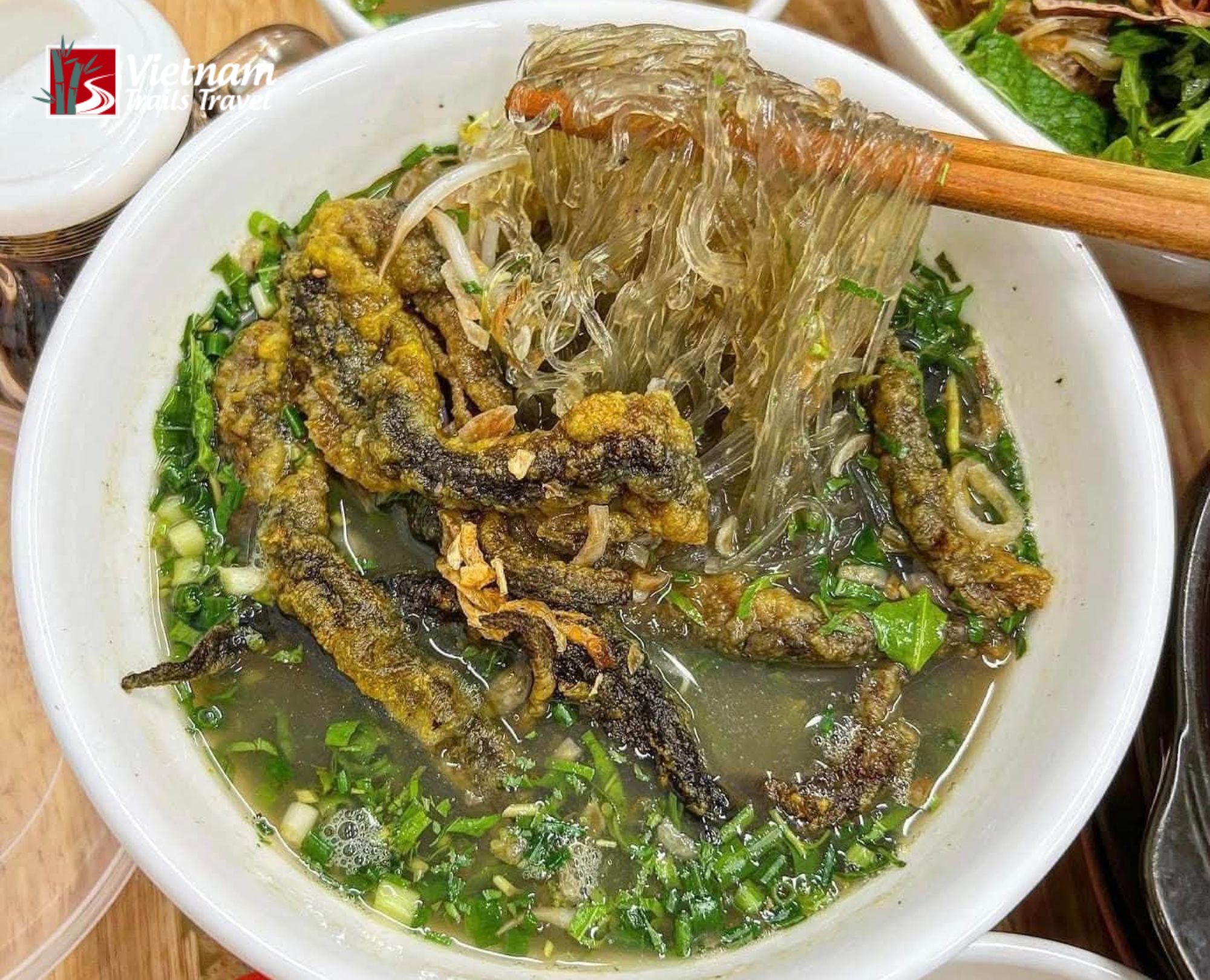
This glass noodle dish comes with eel served two ways, crispy fried or soft, in a light broth built on bones and herbs. Locals eat it for breakfast or a light lunch. Small family shops in the city center make the best versions.
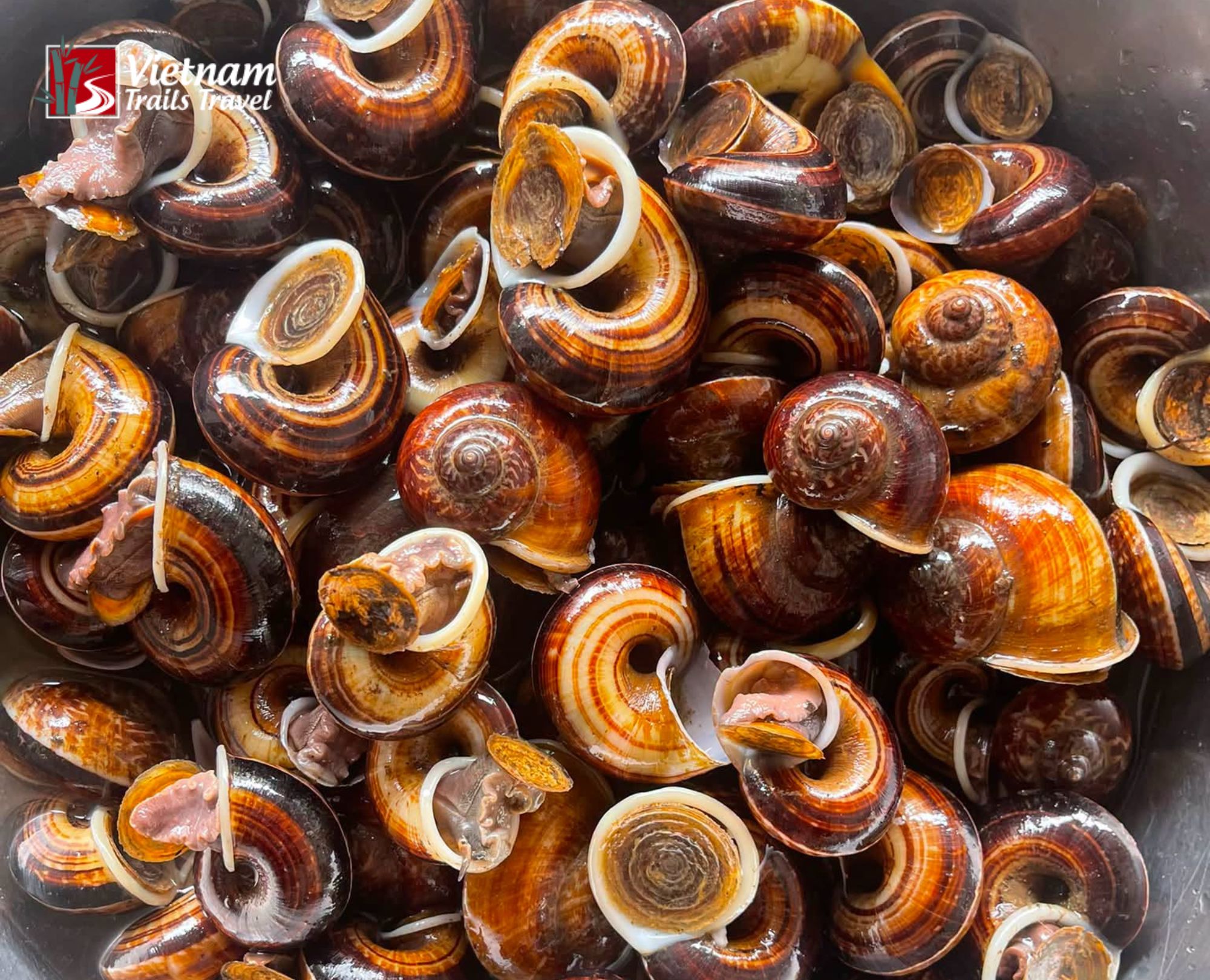
7.4. Ốc núi (mountain snails)
These snails live only in the karst hills and appear on menus mainly from spring to early autumn. Kitchens steam them with lemongrass and serve them with a ginger and chili dipping sauce. The meat is firm and slightly herbal from the wild plants the snails feed on.
7.5. Bánh đa cá rô đồng (field perch noodle soup)
Thick rice noodles arrive in a broth with crispy fried field perch, green vegetables and herbs. The dish makes a satisfying breakfast before an early boat departure.
7.6. Nem chua Yên Mạc (fermented pork rolls)
Yen Mac village has made these tangy pork rolls for generations. Diners wrap them in fig leaves with garlic and chili. Markets and specialty shops sell them in small bundles, and they pair well with a cold beer after a day outside.
Tam Coc also has Western restaurants and cafes for travelers who want a break from local flavors, along with cold drinks and coffee by the river. Vegetarian food is easy to find near the pagodas, and fruit stalls line the roads in summer with lychee, longan, and custard apple in season.
8. Money and currency exchange in Ninh Binh
Vietnam runs on cash for most small purchases, so sort out your money before you travel. The best exchange rates are usually in the capital, at bank branches or the trusted gold shops in the Old Quarter, so many visitors change a larger sum there before heading south.
You can still exchange money and withdraw cash in Ninh Binh without trouble. Note that addresses across the area now list new ward names after the 2025 merger, so do not worry if a map label looks unfamiliar.
Here are five reliable places to change money in the city, with banks first for the best rates. Your passport is required at every bank counter.
1. Vietcombank Ninh Binh branch
Vietcombank handles the widest range of foreign currencies in the province and posts the most competitive bank rates for USD and EUR. Staff at this branch are used to foreign visitors, and the process takes about 15 minutes.
- Address: 1069 Trần Hưng Đạo, Hoa Lư, Ninh Bình.
- Open: Monday to Friday, 07:30 to 11:30 and 13:00 to 17:00.
- Phone: +84 229 3894 444.
2. BIDV Ninh Binh branch
This large branch sits close to the administrative center and exchanges major currencies at rates close to Vietcombank. Queues move faster here on busy mornings.
- Address: Lê Hồng Phong, Đông Thành, Hoa Lư, Ninh Bình.
- Open: Monday to Friday, 08:00 to 11:30 and 13:00 to 16:30.
- Phone: +84 229 3871 519.
3. VietinBank Ninh Binh
A smaller office with attentive staff and standard bank rates. The early opening hour helps if you want to change money before a morning boat departure.
- Address: 81 Lương Văn Tụy, Hoa Lư, Ninh Bình.
- Open: Monday to Friday, 07:00 to 11:30 and 13:30 to 16:30.
- Phone: +84 229 3898 322.
4. Agribank Nam Ninh Binh
Agribank has the densest branch network in the countryside, which helps if you need a counter outside the center. Some staff speak good English, and EUR is handled alongside USD.
- Address: 268 Vân Giang, Hoa Lư, Ninh Bình.
- Open: Monday to Friday, 07:30 to 11:30 and 13:30 to 17:00.
- Phone: +84 229 3622 113.
5. Tiệm Vàng Hương Sơn (gold shop)
This gold shop is the fallback when banks close, since it opens evenings and weekends. Rates for EUR and USD are fair and sometimes match the banks, though smaller currencies may be refused. Count your notes at the counter before you leave.
- Address: 942 Trần Hưng Đạo, Hoa Lư, Ninh Bình.
- Open: daily, 07:00 to 12:00 and 14:00 to 20:30.
- Phone: +84 229 3871 828.
ATMs remain the simplest option for most visitors. Machines sit in the city center, near the train station, and around Tam Coc, and they accept international cards. Withdrawal limits run around 2,000,000 to 5,000,000 VND per transaction with a small fee each time, so one larger withdrawal saves on charges.
Card payment works at larger hotels and a few restaurants, but boat piers, market stalls, and small eateries take cash only. Keep a mix of small notes for tickets, tips, and snacks, since vendors rarely hold change for large bills.
9. Sample Ninh Binh itineraries
A good Ninh Binh itinerary depends on how much time you have. Below are two options, one for a single day and one for two full days. Both use 24 hour times and follow a practical order of sights that limits backtracking.
Ninh Binh day trip from Hanoi
A day trip covers the highlights but moves at a steady pace. The plan below assumes a private car, which gives you control over every time slot. Swap the afternoon order if rain is forecast, since the viewpoint needs dry weather to shine.
06:45 Your driver meets you at the hotel lobby. Traffic out of the center is still light at this hour, and the luggage stays in the car all day.
07:00 Leave Hanoi on the expressway. The drive south takes about 1.5 hours, with one optional rest stop on the way.
08:30 Arrive at the Trang An pier and buy boat tickets, around 300,000 VND per adult. Toilets, coffee stands, and a left luggage counter sit beside the ticket office.
09:00 Board a sampan for the route through the grottoes and temple stops. The ride lasts 2.5 to 3 hours on calm water, so apply sunscreen and put on a hat before you set off. Each boat carries four passengers plus the rower.
12:00 Lunch near Tam Coc. Goat meat and crispy rice are the classic local pairing, and most restaurants around the pier serve both. Allow about an hour to eat and rest.
13:15 Drive 15 minutes to the temples of the ancient capital at Truong Yen. The two main halls, the courtyards, and the old walls take about an hour on foot, and the grounds stay shaded for most of the walk.
14:45 Continue 10 minutes to the valley viewpoint. The stair climb takes 20 to 30 minutes at an easy pace, and the panorama over the Ngo Dong valley rewards the effort. Buy water at the base before you start.
16:15 Cool down with a coffee or fresh coconut near the parking area.
16:45 Begin the return drive north.
18:15 Arrive back at your hotel in Hanoi.
This schedule packs the main sights into roughly 11 hours. A private car keeps the timing tight, skips station transfers, and lets you reorder stops if the weather shifts. A single day works and rewards the effort, though it leaves little slack, so an overnight stay is the more relaxed choice when your plans allow it.
2 days in Ninh Binh
Two full days let you split the two waterway routes across separate mornings, add sunset time, and eat well without rushing. The plan below assumes one night near Tam Coc.
Day 1
09:00 Arrive from Hanoi and drop your bags at your hotel or homestay near Tam Coc. Early check in is common outside peak weekends, and reception will hold luggage either way.
09:45 Rent bicycles and ride the flat lanes through the paddies toward the villages south of town. A gentle loop takes one to two hours, with photo stops wherever the karst walls meet the fields.
12:00 Lunch in Tam Coc town. Local places near the pier serve goat dishes, noodle soups, and Western options.
13:30 Take the Tam Coc boat tour on the Ngo Dong River, about 1.5 to 2 hours past the three grottoes. Afternoon light suits the open scenery here, and the rowers work the oars with their feet.
15:45 Cycle 10 minutes to Bich Dong Pagoda and walk its three levels up the cliff face. Entry is free and the crowds thin out late in the day.
17:00 Ride to the valley viewpoint for sunset. The gate closes at 19:00, and the last light over the fields is the best of the day.
19:00 Dinner in Tam Coc. Goat hotpot suits a group after a full day outdoors.
Day 2
06:30 Early breakfast at your accommodation.
07:00 Reach the Trang An pier as it opens. The first boats of the morning get still water, soft light, and the fewest people on the routes.
10:15 Drive 10 minutes to the ancient capital at Truong Yen, if you skipped it on a previous visit, and give the temples about an hour.
11:30 Lunch on the road toward Bai Dinh.
13:00 Explore Bai Dinh Pagoda, using the electric buggy to cover the long corridors and the giant Buddha hall. Two hours covers the main halls at a steady pace.
15:30 Return to the hotel, freshen up, and collect your bags.
16:00 Depart for Hanoi, arriving around
With two days you also have time for Van Long or Cuc Phuong if wildlife and quiet scenery appeal to you. A third day would fit both without any rush, plus a slow morning on the back lanes around Tam Coc.
10. Guided tours and hiring a local guide
Most travelers explore Ninh Binh on their own, since the sites are easy to reach and the boat rowers handle the routes on the water. A guide is not required, though one adds real context if you care about the history behind the temples and the ancient capital.
You have a few options for guided support. A full day tour from the capital arrives with a guide, transport, and tickets in one package, which suits first time visitors who want a set plan and no logistics to manage.
Local guides can also be hired by the day, often through your hotel or a tour desk in Tam Coc, for around 500,000 to 900,000 VND depending on the language and the length of the day.
English speaking guides are the most common, and some also cover French, Korean, or Chinese. For a private trip, Vietnam Trails Travels can pair an English speaking driver with a licensed guide, so you get smooth transport and background on each stop in one booking.
A guide earns its cost most at the historical sites, where the signs are brief, and matters least on the water, where the scenery needs no explanation.
11. Ninh Binh travel guides
A few small preparations make a Ninh Binh trip smoother. Cash matters here, since many boat piers, small restaurants, and parking areas do not take cards, though ATMs are available in the town center and Tam Coc. Comfortable shoes help on the viewpoint climb and the temple grounds, where surfaces are uneven.
Modest dress is expected at Hoa Lu, Bai Dinh, and other temples, so cover your knees and shoulders out of respect. A hat, sunscreen, and water are useful on the boat tours and climbs, where shade is limited.
A light rain jacket earns its place in any season. A local SIM or eSIM keeps Grab and maps working, and coverage across the province is generally reliable.
Boat rowers and site staff sometimes expect a small tip, so keep a few small notes on hand. Book boat tickets and private transport a day ahead on weekends and during Vietnamese holidays, when the main sites get busy.
Start early wherever you can, since mornings are cooler, quieter, and better for photos. Watch your footing on wet stone at the viewpoints, and give the boats plenty of time so you are not rushed on the water.
Money is simple to manage. Carry enough cash for the day, since card machines are rare at the smaller sites, and top up at an ATM in town when needed. Health risks are low, though mosquito repellent helps near the water in the warmer months and bottled or filtered water is the safe choice for drinking.
At the temples, keep your voice low, remove your hat inside the halls, and ask before photographing people at prayer. Small courtesies go a long way with local staff and rowers.
12. Frequently asked questions
12.1. How many days do you need in Ninh Binh?
Two full days let you see the main sights at a comfortable pace, including both boat tours, the old capital, and the valley viewpoint. A single day covers the highlights if you are short on time, though it feels rushed. Three or four days suit travelers who want to add Van Long or Cuc Phuong.
12.2. Is a day trip worth it?
Yes. The route covers Trang An or Tam Coc, Hoa Lu, and the Mua Cave viewpoint, and the drive is only about 1.5 to 2 hours each way. An overnight stay is better if your schedule allows, since it eases the pace and adds sunset and early morning time.
12.3. Trang An or Tam Coc, which is better?
Trang An is longer and passes more caves and temples, while Tam Coc is shorter, cheaper, and has open rice field views. For one trip only, the Trang An boat tour gives more variety. Doing both on separate mornings is ideal if you have two days.
12.4. When should you go?
March to May and September to November have the best weather. The golden rice season in late May and June is the most scenic for photos along the Ngo Dong River.
12.5. Is there an airport in Ninh Binh?
No. The nearest airport is in Hanoi, about 95 kilometers away. From there you reach the province by private car, limousine van, train, or bus.
12.6. Can you get around Ninh Binh without a motorbike?
Yes. Bicycles cover the Tam Coc area easily, and Grab, taxis, or a private car with a driver handle the longer distances between sites.
12.7. Is Ninh Binh safe for tourists?
Yes. The area is calm and welcoming, with low crime and friendly locals. The main things to watch are slippery steps at the viewpoints and traffic on the roads if you rent a motorbike.
12.8. Do you need a guide in Ninh Binh?
Not for most sights. The rowers point out the main features, and the temples carry signs in English. A guide adds value if you want deeper history at the old capital, or a driver who explains the area as you go.
12.9. Is Ninh Binh good for families?
Yes. The boat tours are calm and short enough for children, the walking is manageable, and the countryside gives kids space to move. A private car with a driver makes the day easier with young children or older relatives.
12.10. How does Ninh Binh compare with Halong Bay?
The two share the same limestone scenery, but the setting differs. Halong Bay sits on the sea, while this region spreads across rivers and fields inland. Many travelers visit both on one trip, since they lie within a few hours of each other.
13. Plan your trip with Vietnam Trails Travels
Ninh Binh rewards a bit of planning. The sights sit close together, but the timing of boat tours, temple visits, and the drive matters if you want a smooth day. Vietnam Trails Travels arranges private cars with English-speaking drivers and full-day tours across the province, with hotel pickup and a guaranteed on-time return. Reach out through vietnamtrailstravels.com to set your route, and travel Ninh Binh at your own pace.
